How to Read a Cannabis Certificate of Analysis (COA): Complete Guide
A cannabis Certificate of Analysis, commonly called a COA, is one of the most useful documents available when evaluating a cannabis or cannabinoid product.
Product packaging can say:
Premium.
Lab tested.
High potency.
Solventless.
Pure.
But a properly matched laboratory report can provide something much more useful: actual analytical results for a particular sample or batch.
Depending on what testing was performed, a cannabis COA may report concentrations of THCA, delta-9 THC, CBD and other cannabinoids, while additional panels may cover pesticides, heavy metals, residual solvents, microorganisms or mycotoxins.
However, simply having a PDF with laboratory numbers doesn’t automatically prove that a product is high quality—or even that the report belongs to the product in your hand.
You need to know how to read it.
This complete guide explains how to evaluate a cannabis Certificate of Analysis, understand cannabinoid potency, interpret THCA and total THC, verify batch information, identify contaminant panels and recognize common warning signs.
What Is a Cannabis Certificate of Analysis?
A Certificate of Analysis is a document reporting the analytical results produced from testing a sample.
For cannabis products, laboratories may analyze a sample for different characteristics depending on the requested test panel and applicable regulatory requirements.
These can include:
- Cannabinoid potency
- Pesticides
- Heavy metals
- Residual solvents
- Microbial contaminants
- Mycotoxins
- Moisture or water activity
- Other product-specific analyses
The key phrase is “depending on the test panel.”
A laboratory report showing cannabinoid potency does not automatically mean the same sample was tested for pesticides, heavy metals and microorganisms.
This distinction is extremely important.
Why Does a Cannabis COA Matter?
A COA helps replace assumptions with measurements.
Suppose a package says:
25% THCA.
Without laboratory documentation, that’s simply a label claim.
A cannabinoid analysis can provide measured values for that tested sample.
Similarly, a product described as “lab tested” may sound reassuring, but the phrase alone doesn’t tell you:
Which laboratory performed the analysis?
What was tested?
Which batch was tested?
When was it tested?
Did the sample pass applicable specifications?
Does the report actually correspond to the product?
Reading the COA helps answer those questions.
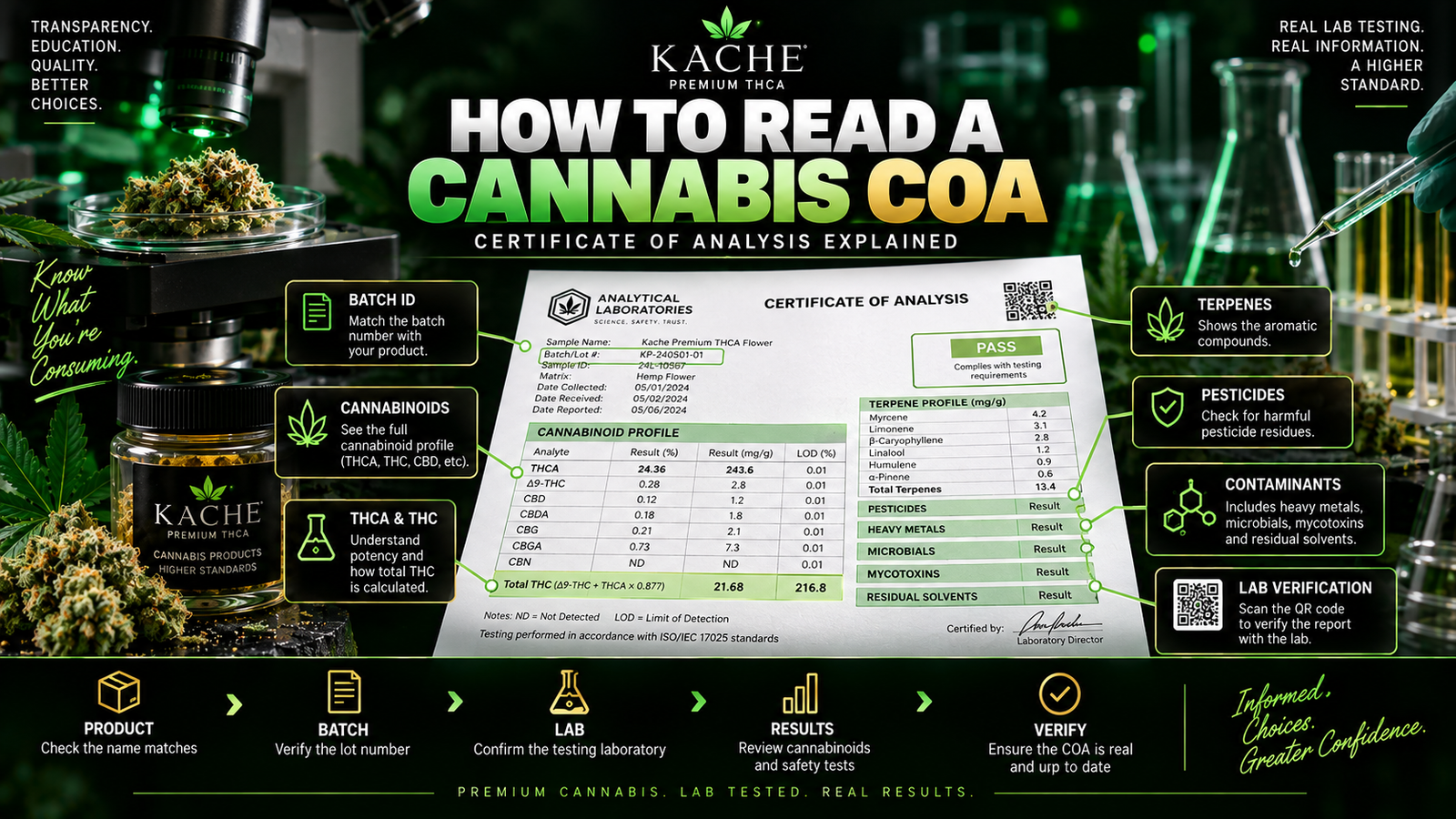
Step 1: Identify the Laboratory
Start at the top of the report.
Find the name of the laboratory responsible for the analysis.
A legitimate COA should clearly identify the testing laboratory rather than presenting unexplained numbers on a generic document.
Depending on the jurisdiction and testing program, laboratory accreditation or regulatory requirements may also apply.
For example, USDA’s hemp testing framework requires laboratories testing hemp for federal production-program purposes to follow specified sampling and analytical requirements. USDA also explains that laboratories calculate total THC in a way that accounts for the potential conversion of THCA into THC.
USDA Laboratory Testing Guidelines for Hemp
For a retail product, the relevant requirements may differ by state and product category, but identifying the laboratory remains an important first step.
Step 2: Match the Product Name
Next, find the product or sample name listed on the COA.
Compare it with the product you’re evaluating.
If you’re holding a package labeled:
Kache Premium Live Rosin
but the laboratory report is for an unrelated flower product, that report doesn’t establish the composition of your live rosin.
Names don’t always match character-for-character because laboratories and manufacturers may use internal naming conventions.
Still, the information should make sense.
Step 3: Match the Batch or Lot Number
This is one of the most important checks on the entire document.
Look for terms such as:
Batch
Lot
Sample ID
METRC ID
or another identifying number.
Then compare the relevant identifier with the product packaging where available.
Why?
Because cannabis products are produced in batches.
Testing one batch doesn’t automatically establish the composition of every future batch carrying the same product name.
A batch-specific report provides a much stronger connection between the laboratory analysis and the actual product.
Step 4: Check the Dates
COAs can contain several dates.
You may see:
Sample received
Sample collected
Testing started
Testing completed
Report issued
These dates provide useful context.
A report from years ago shouldn’t automatically be treated as evidence for a newly manufactured batch.
Again, the objective is to establish a chain:
Product → Batch → Sample → Laboratory → Results
The clearer that chain is, the more useful the COA becomes.
Step 5: Find the Cannabinoid Potency Panel
For many consumers, this is the most familiar section.
The cannabinoid panel can contain compounds such as:
THCA
Delta-9 THC
CBDA
CBD
CBGA
CBG
CBN
and others.
Exactly which cannabinoids appear depends on the laboratory’s analytical method and reporting panel.
Don’t assume every cannabinoid listed is present.
Some may show:
ND
meaning Not Detected, depending on the laboratory’s terminology.
Others may show a result below a reporting or quantitation threshold.
How to Read THCA on a COA
THCA stands for tetrahydrocannabinolic acid.
It is chemically related to delta-9 THC, but they aren’t identical molecules.
THCA is the acidic precursor that can convert into delta-9 THC through decarboxylation.
This transformation is central to understanding cannabis potency.
If you want the full chemistry explanation, read our:
THCA vs THC: What’s the Difference?
For high-THCA flower, you may see a cannabinoid panel where THCA represents a much larger percentage than delta-9 THC.
That isn’t necessarily contradictory.
It reflects the cannabinoid forms measured in the sample.
THCA Percentage vs Delta-9 THC Percentage
Suppose a hypothetical flower COA reports:
THCA: 24.00%
Delta-9 THC: 0.20%
You should not simply add:
24.00 + 0.20 = 24.20%
when estimating potential total THC.
Why?
Because converting THCA into THC involves a change in molecular mass.
That is why total THC calculations commonly use a conversion factor.
How Is Total THC Calculated?
A commonly used calculation is:
Total THC = Delta-9 THC + (THCA × 0.877)
The 0.877 factor accounts for the difference in molecular weight when THCA loses carbon dioxide during decarboxylation.
USDA specifically requires hemp testing to account for the conversion of THCA into THC through a post-decarboxylation method or another similarly reliable analytical approach.
Using our hypothetical example:
THCA = 24.00%
24 × 0.877 = 21.048%
Add 0.20% delta-9 THC:
Estimated Total THC = 21.248%
or approximately:
21.25% Total THC
This is why THCA percentage and total THC aren’t identical numbers.
Why the 0.877 Factor Matters
The factor isn’t an arbitrary cannabis-industry number.
THCA and THC have different molecular masses.
When THCA decarboxylates, it loses a carboxyl group as carbon dioxide.
The resulting THC therefore weighs less than the original THCA molecule.
The conversion factor accounts for this difference.
For a deeper explanation of THCA itself, see:
What Is THCA Flower? Complete Beginner’s Guide
What Does “Total Cannabinoids” Mean?
You may also encounter:
Total Cannabinoids
This isn’t necessarily the same as total THC.
It may represent a calculated sum of cannabinoids reported by the laboratory according to its methodology.
Therefore, don’t confuse:
THCA
Total THC
and
Total Cannabinoids.
They describe different measurements or calculations.
Read the report’s notes to understand how the laboratory defines each figure.
What Does ND Mean on a Cannabis COA?
ND usually means:
Not Detected.
But that does not necessarily mean there are literally zero molecules of that compound in the product.
It generally means the analyte wasn’t detected according to the laboratory’s analytical criteria.
This brings us to two important laboratory concepts:
LOD
and
LOQ.
What Is LOD?
LOD means:
Limit of Detection.
It refers to the lowest concentration at which an analytical method can reliably distinguish the presence of an analyte from background noise under the method’s conditions.
Think of it as:
Can the instrument tell that something is there?
What Is LOQ?
LOQ means:
Limit of Quantitation.
It generally represents the concentration above which the laboratory can quantify an analyte with an acceptable level of precision and accuracy according to its validated method.
Think of the difference as:
LOD → We can detect it.
LOQ → We can reliably quantify it.
The exact definitions and reporting conventions can vary between analytical methods and laboratories, so read the notes accompanying the report.
Percent vs Milligrams per Gram
Cannabis COAs may express cannabinoid concentration in different units.
Two common formats are:
% by weight
and
mg/g
A useful general conversion is:
1% by weight = 10 mg/g
Therefore:
20% = 200 mg/g
25% = 250 mg/g
30% = 300 mg/g
This is particularly useful when comparing reports that use different units.
But gummies and other individually portioned products can also be reported in terms such as milligrams per unit or serving.
Always read the unit.
A number without its unit can be misleading.
Reading a THCA Flower COA
When reviewing flower, start with the cannabinoid panel.
Look at:
THCA
Delta-9 THC
Total THC
CBD/CBDA
CBG/CBGA
Then move beyond potency.
Depending on the testing program, look for contaminant results and other quality-related measurements.
If you’re learning about the product itself, read:
THCA Flower vs Regular Weed: What’s the Difference?
The COA helps you move from visual assumptions to actual analytical data.
Reading a Concentrate COA
Concentrates require many of the same checks.
However, their manufacturing methods can make certain test panels particularly relevant.
For example, a concentrate produced using hydrocarbon extraction may warrant close attention to residual-solvent results.
A solventless concentrate such as live rosin doesn’t use hydrocarbon solvents as part of its defining extraction method, but that doesn’t mean contaminant testing becomes irrelevant.
Read:
What Is Live Rosin? Complete Guide
and:
Live Rosin vs Live Resin: What’s the Difference?
to understand why extraction method matters.
Reading a THCA Diamonds COA
THCA diamonds are concentrated crystalline cannabinoid products.
Consequently, the cannabinoid panel can show very high THCA concentrations in highly purified products.
However, never assume:
“Diamonds = 99% THCA.”
Actual composition depends on the individual product.
Check the analysis.
If solvent-based processing was used, residual-solvent testing may also be relevant.
Our full guide explains the category:
Reading a Cannabis Gummies COA
Edibles introduce another issue:
serving size.
Suppose a laboratory report gives cannabinoid content for the complete sample.
The retail package, meanwhile, contains multiple gummies.
You need to understand whether the reported amount represents:
Per gummy
Per serving
Per package
or another measurement basis.
Do not automatically assume the biggest milligram figure refers to a single gummy.
Our edible guide explains this distinction:
What Are THCA Gummies? Complete Guide
You can also compare cannabinoid formulations here:
THCA Gummies vs Delta-9 Gummies: Key Differences
What Is a Pesticide Panel?
Cannabis cultivation can involve exposure to agricultural chemicals.
A pesticide analysis tests for specified compounds according to the laboratory’s method and applicable testing requirements.
Results may be displayed as:
ND
Pass
Fail
or numerical concentrations.
The exact compounds and allowable limits depend on the applicable jurisdiction and testing program.
This is why simply seeing:
“Pesticide Tested”
isn’t as informative as seeing the actual panel.
What Is Heavy-Metal Testing?
Heavy-metal analysis checks for specified elemental contaminants.
Cannabis testing programs may include metals such as:
Lead
Cadmium
Arsenic
Mercury
depending on applicable requirements.
Why does this matter?
Plants can take up elements from their environment, and contamination can also arise from manufacturing or other sources.
Again, the presence of a cannabinoid potency test does not prove that heavy-metal testing was performed.
Look for the actual panel.
What Is Residual-Solvent Testing?
Residual-solvent testing is particularly relevant to products manufactured using solvent-based extraction.
Cannabis extraction can use substances such as:
Butane
Propane
Ethanol
and other processing solvents, depending on the method.
After extraction, manufacturers use downstream processes to remove solvents.
Laboratory testing can then determine whether specified residual solvents are present at measured concentrations.
This is especially relevant when comparing:
Live resin
with
Live rosin.
Live resin is generally produced using solvent extraction.
Live rosin is generally categorized as solventless.
But don’t infer the complete contaminant profile from extraction terminology alone.
What Is Microbial Testing?
Microbial testing can look for microorganisms or indicators specified by the applicable testing program.
Depending on the method and jurisdiction, testing may address organisms such as certain:
Bacteria
Yeasts
Molds
or particular pathogenic organisms.
Microbial testing matters because cannabis products are biological materials and can be exposed to contamination during cultivation, handling, processing or storage.
The exact testing requirements vary.
Therefore, inspect the actual laboratory panel instead of assuming that “lab tested” includes microbiological analysis.
What Are Mycotoxins?
Mycotoxins are toxic compounds produced by certain fungi.
Cannabis testing programs may test for specific mycotoxins, such as particular aflatoxins or ochratoxin A, depending on jurisdiction and product requirements.
This is separate from simply testing whether mold or yeast is present.
That’s another reason cannabis testing can contain multiple independent panels.
What Is Water Activity?
Some cannabis laboratory reports include:
Water activity, often written as aw.
Water activity is not simply the same as moisture percentage.
It relates to the availability of water within a product for biological or chemical processes.
For dried cannabis flower, water activity can provide useful information in the context of product stability and microbial risk.
If a COA includes both moisture and water activity, don’t assume they represent the same measurement.
What Is Moisture Content?
Moisture content describes the amount of water present in a sample according to the analytical method used.
For flower, moisture can influence how potency results are interpreted, especially when comparing results reported on different bases.
This is another reason two potency numbers from two different reports shouldn’t always be compared without understanding the reporting method.
What Does “Pass” Mean?
A Pass result generally means the tested sample met the laboratory or regulatory specification applied to that particular analyte or panel.
It does not mean:
“This product is completely risk-free.”
A sample can pass one panel without having been tested for every possible contaminant.
For example:
Pesticides: Pass
doesn’t automatically mean:
Heavy metals: Pass
unless heavy metals were actually tested.
Always determine what the word “Pass” refers to.
Does “Lab Tested” Mean Everything Was Tested?
No.
This is perhaps the most important lesson in this entire guide.
A company could technically have a product analyzed only for cannabinoid potency and describe it as:
Lab tested.
That phrase alone doesn’t tell you whether the laboratory also analyzed:
Pesticides
Heavy metals
Microbes
Mycotoxins
or
Residual solvents.
The COA should show what was actually analyzed.
Does a QR Code Prove a Product Is Lab Tested?
No.
A QR code is simply a link.
It can point almost anywhere.
When you scan a cannabis product’s COA QR code, verify the destination.
Ideally, it should provide access to relevant laboratory information for the product or batch.
Then check:
Product
Batch
Dates
Laboratory
Cannabinoid results
Contaminant panels
The QR code itself proves none of those things.
How to Spot a Suspicious Cannabis COA
A few warning signs deserve closer attention.
Product mismatch
The report doesn’t correspond to the product being sold.
Batch mismatch
The package and report identify different batches.
Very old report
An old COA is being used for a newly produced product without a clear batch connection.
Missing laboratory identity
You can’t determine who performed the analysis.
Potency-only testing presented as comprehensive testing
The seller claims “fully tested,” but the report contains only cannabinoids.
Cropped or incomplete report
Important identifying information is missing.
Unexplained numbers
Results appear without clear units or analytical context.
Impossible or inconsistent information
The numbers, dates or identifiers contradict one another.
None of these automatically proves fraud, but they justify further verification.
Can a COA Be Fake?
Documents can be altered or misrepresented.
That’s why verification shouldn’t stop at seeing a PDF.
Where possible, look for:
Laboratory identification
Report or sample ID
Batch information
Verification links
QR codes linked to laboratory-hosted results
Consistent dates and product information
If the laboratory offers direct report verification, that can provide another useful check.
Why Laboratory Accreditation Matters
Accreditation helps demonstrate that a laboratory operates according to specified quality and competency requirements for its scope.
For example, ISO/IEC 17025 is widely used internationally for testing and calibration laboratory competence.
However, seeing “ISO 17025” on a page doesn’t mean every conceivable cannabis test is covered.
Accreditation has a defined scope.
If verification is particularly important, check what methods or analyses fall within the laboratory’s accredited scope.
ISO overview of ISO/IEC 17025 testing laboratory competence
Why Cannabis Lab Results Can Differ
Two laboratories can sometimes report different results for samples from what appears to be the same product.
Potential reasons include:
Sampling differences
Natural product variability
Sample preparation
Analytical methodology
Measurement uncertainty
Moisture differences
Instrument calibration
This doesn’t mean laboratory testing is useless.
It means analytical numbers should be interpreted in context rather than treated as magical absolute values.
What Is Measurement Uncertainty?
Every analytical measurement has some degree of uncertainty.
A laboratory result such as:
25.0% THCA
shouldn’t necessarily be interpreted as an infinitely precise statement that every particle in the entire production batch contains exactly 25.0% THCA.
Laboratories analyze samples.
Those samples represent a larger batch according to the sampling procedure.
This is one reason proper sampling is just as important as sophisticated instruments.
Why Sampling Matters
Imagine a large batch of cannabis flower.
Different buds may have slightly different cannabinoid concentrations.
If the sample submitted to the laboratory doesn’t adequately represent the batch, the result may not perfectly characterize everything in the batch.
Testing programs therefore establish sampling procedures designed to produce representative samples.
USDA’s hemp program specifically addresses sampling and testing procedures as part of compliance determination.
This illustrates a broader principle:
Good laboratory analysis starts before the sample reaches the instrument.
Does the Highest THCA Percentage Mean the Best Product?
No.
A COA is extremely useful, but it can also encourage consumers to focus too heavily on one number.
A flower testing at a higher THCA percentage isn’t automatically:
Better grown
Better tasting
Better cured
More aromatic
Cleaner
or
Better suited to a particular consumer.
Cannabinoid potency is one characteristic.
Quality involves more than potency.
This principle also applies to concentrates and gummies.
What About Terpene Testing?
Some COAs include a terpene panel.
Terpenes are volatile compounds associated with cannabis aroma.
A terpene panel may report compounds such as:
Myrcene
Limonene
Beta-caryophyllene
Linalool
Pinene
and others.
This can help characterize the product’s aromatic chemistry.
However, terpene measurements should not be turned into unsupported medical claims.
For example, detecting limonene doesn’t prove that a particular cannabis product treats anxiety or disease.
Chemical analysis and clinical claims are different things.
A Simple Cannabis COA Checklist
Before relying on a report, ask:
- Which laboratory tested it?
- Does the product name match?
- Does the batch or lot match?
- Are the dates appropriate?
- Which cannabinoids were measured?
- What units are being used?
- Was pesticide testing performed?
- Was heavy-metal testing performed?
- Was microbial testing performed?
- Were mycotoxins tested where relevant?
- Were residual solvents tested where relevant?
- Can the report be independently verified?
That simple process makes COAs far easier to evaluate.
How Kache Customers Should Use COAs
At Kache Premium, laboratory information should be treated as part of understanding the individual product—not merely as a marketing badge.
When reviewing a product, connect four pieces of information:
Product → Batch → COA → Results
For flower, examine cannabinoid composition and the testing panels provided.
For concentrates, consider the extraction method and relevant analytical panels.
For gummies, pay particular attention to cannabinoid amounts and whether figures refer to individual pieces, servings or the complete package.
You can explore the current:
Kache Premium THCA Concentrates
and:
and use the principles in this guide when evaluating individual products.
Cannabis COA Myths
Myth: “Lab tested” means every contaminant was tested.
False. Check the actual panels.
Myth: A QR code proves laboratory testing.
False. It is merely a way to link information.
Myth: THCA and delta-9 THC are the same laboratory value.
False. They’re chemically distinct cannabinoids.
Myth: 30% THCA means 30% total THC.
False. Potential total THC calculations account for the molecular-mass change during decarboxylation.
Myth: ND always means absolutely zero.
Not necessarily. It generally means the analyte wasn’t detected according to the laboratory’s analytical criteria.
Myth: The highest potency product is automatically the highest-quality product.
False. Potency is only one quality characteristic.
Myth: A potency COA proves a product is contaminant-free.
False.
Myth: Every COA online belongs to the current batch.
Never assume this. Match the identifiers.
Frequently Asked Questions About Cannabis COAs
What does COA mean in cannabis?
COA means Certificate of Analysis, a laboratory document reporting analytical results for a tested sample.
What should a cannabis COA show?
Depending on the tests performed, it may show cannabinoid potency and results for pesticides, heavy metals, residual solvents, microorganisms, mycotoxins or other analyses.
What does THCA mean on a COA?
THCA is tetrahydrocannabinolic acid, the acidic cannabinoid precursor that can convert into delta-9 THC through decarboxylation.
What does ND mean?
ND commonly means Not Detected according to the laboratory’s analytical and reporting criteria.
What is total THC?
Total THC is a calculation designed to account for measured delta-9 THC plus the potential THC contribution from THCA.
How is total THC calculated?
A commonly used formula is:
Total THC = Delta-9 THC + (THCA × 0.877)
What does “Pass” mean?
It generally means the tested sample met the applied specification for the particular analyte or panel. It does not mean the product was tested for everything.
Does a QR code prove the COA is real?
No. Follow the QR code and verify the laboratory, product, batch and report details.
Should concentrates have residual-solvent testing?
Residual-solvent analysis is particularly relevant to solvent-extracted products. Applicable requirements vary by product and jurisdiction.
Is a higher THCA percentage always better?
No. Potency is one characteristic and doesn’t establish overall quality.
Final Thoughts: How to Read a Cannabis Certificate of Analysis
A cannabis Certificate of Analysis is most useful when you understand what it can—and cannot—tell you.
Don’t simply search the page for the largest THCA number.
Start at the beginning.
Identify the laboratory.
Match the product.
Match the batch.
Check the dates.
Read the cannabinoid panel.
Understand the units.
Then look beyond potency.
Determine whether the product was actually analyzed for relevant:
Pesticides
Heavy metals
Residual solvents
Microorganisms
Mycotoxins
and other applicable contaminants.
Most importantly, remember this:
“Lab tested” is a claim. A properly matched COA shows you what was actually tested.
That principle applies whether you’re evaluating THCA flower, live rosin, live resin, diamonds or gummies.
For more background, continue through our educational guides:
Together, these articles form the foundation of the Kache Premium cannabis education library.