What Is THCA Flower? Complete Beginner’s Guide
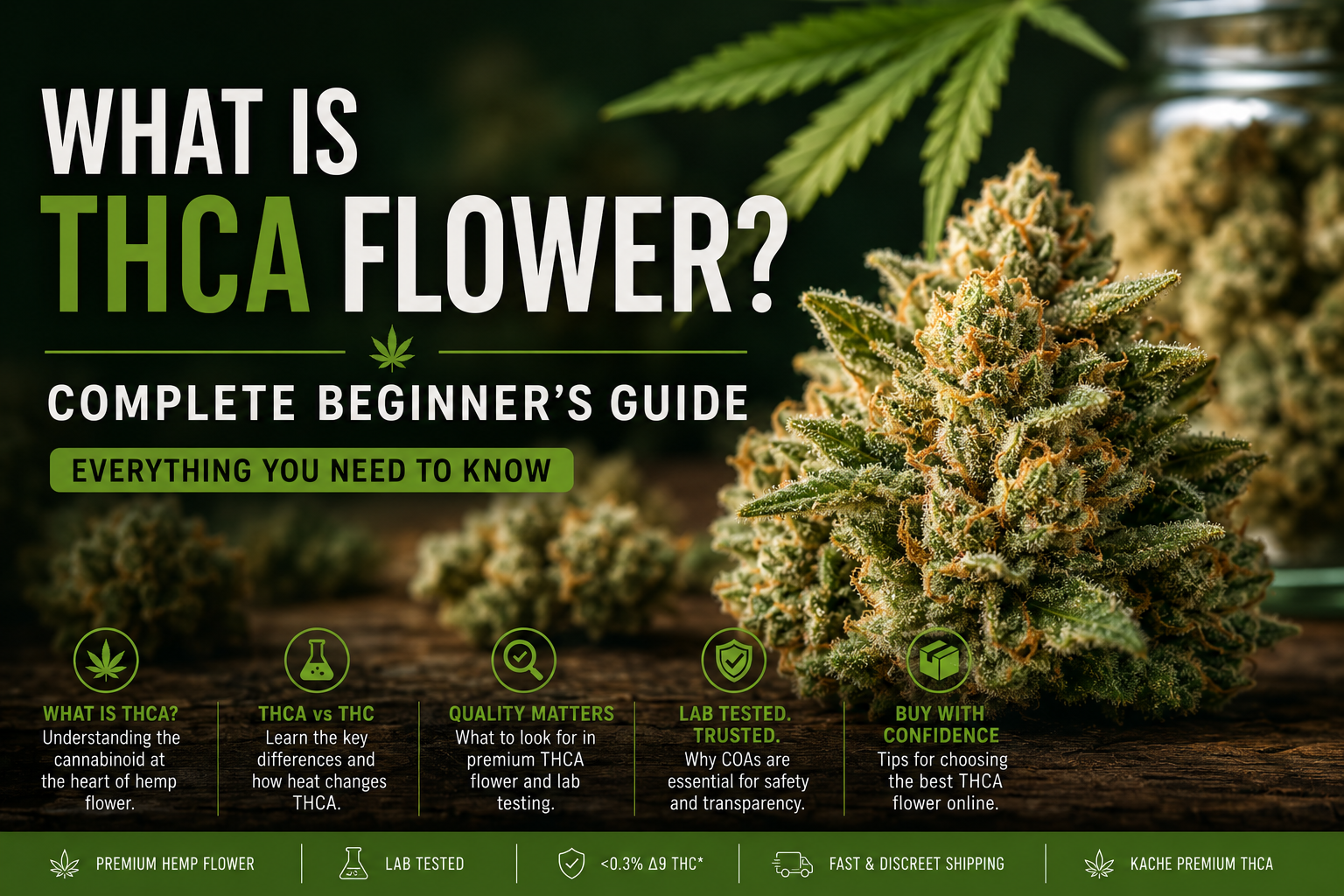
What Is THCA Flower?
THCA flower has become one of the most talked-about products in the cannabinoid market, but its name can create plenty of confusion.
What exactly is THCA? How is THCA flower different from conventional cannabis flower? Why do product labels distinguish between THCA and delta-9 THC? And what should consumers look for when evaluating flower quality?
The simplest place to start is with the plant itself.
THCA stands for tetrahydrocannabinolic acid. It is an acidic cannabinoid naturally produced by Cannabis sativa. THCA is chemically related to delta-9 THC, but the two compounds aren’t identical.
In fresh cannabis, cannabinoids occur substantially in acidic precursor forms. THCA is one of those compounds. When sufficient heat is applied, THCA can lose part of its molecular structure through a chemical reaction called decarboxylation, producing delta-9 THC.
Understanding that relationship is the key to understanding THCA flower.
In this guide, we’ll explain the chemistry in straightforward language, look at what defines high-quality flower, explain certificates of analysis and discuss some of the questions consumers should investigate before purchasing cannabinoid products.
What Does THCA Stand For?
THCA means tetrahydrocannabinolic acid.
Cannabis plants manufacture numerous cannabinoids, and the chemistry of a living plant isn’t quite the same as many people imagine from seeing THC percentages on retail products.
Scientific literature describes THCA as an acidic precursor to delta-9 THC. THCA accumulates particularly within glandular trichomes on cannabis flowers and leaves.
Those trichomes are the tiny resin-producing structures that can give mature cannabis flower its crystalline or frosted appearance.
This distinction between THCA and THC matters because THCA can undergo decarboxylation.
In simplified terms:
THCA → heat/time → delta-9 THC
That doesn’t mean the two names can be used interchangeably. They describe different chemical compounds.
THCA vs THC: What’s the Difference?
One of the most frequent questions surrounding THCA flower is whether THCA and THC are the same thing.
They aren’t.
THCA is an acidic cannabinoid, whereas delta-9 THC is its corresponding neutral cannabinoid.
The difference involves a carboxyl group present in THCA. During decarboxylation, that group is removed and carbon dioxide is released, producing THC.
This relatively small structural change produces an important difference in pharmacology.
THCA itself is generally described in scientific literature as non-intoxicating in the manner associated with delta-9 THC. Once THCA is converted to THC, however, the resulting THC can produce intoxicating effects.
This is also why simply looking at one number on a cannabinoid label can be misleading.
Consumers should examine the entire cannabinoid analysis rather than assuming that “THCA percentage” and “delta-9 THC percentage” mean exactly the same thing.
What Happens When THCA Is Heated?
The conversion of THCA into THC is known as decarboxylation.
Scientific studies have examined this process at different temperatures and exposure times. The general conclusion is straightforward: temperature and time influence the rate at which acidic cannabinoids convert into their corresponding neutral cannabinoids.
Decarboxylation isn’t exclusive to THCA.
Other cannabinoid pairs include:
- CBDA → CBD
- CBGA → CBG
- THCA → THC
This chemistry helps explain why the cannabinoid composition measured in fresh plant material can differ from what exists after substantial heating.
Decarboxylation can also occur gradually during storage, although heating dramatically accelerates the process.
This is one reason proper storage and product handling matter.
Where Does THCA Come From?
THCA isn’t simply something sprayed onto ordinary plant material by definition.
It is a cannabinoid that Cannabis sativa naturally biosynthesizes.
As cannabis plants develop, glandular trichomes become important sites of cannabinoid production and accumulation. Mature flowers can become densely covered with these resin-producing structures.
Cultivar genetics, cultivation conditions, maturity, post-harvest handling and storage can all influence the characteristics of the finished flower.
This is why two flower products marketed under the same broad category can look, smell and test quite differently.
At Kache Premium, we believe flower should be evaluated as an agricultural product first—not simply as a percentage printed on a package.
What Does High-Quality THCA Flower Look Like?
Potency is only one characteristic of flower quality.
Experienced consumers often evaluate several characteristics simultaneously.
1. Trichome Coverage
High-quality mature flower frequently displays substantial trichome development.
Under magnification, glandular trichomes can look like tiny stalks with rounded heads. These structures are particularly important because cannabinoids and many aromatic compounds are associated with the plant’s resin.
A heavily frosted appearance can therefore be one useful visual characteristic.
It isn’t, however, a substitute for laboratory analysis.
2. Flower Structure
Flower structure varies by genetics.
Some cultivars naturally produce dense, compact flowers, while others develop more elongated structures.
Consequently, bigger or denser doesn’t automatically mean better.
We look for flower that appears properly developed and handled rather than judging quality according to a single shape.
3. Aroma
Cannabis aroma is influenced substantially by volatile compounds, including terpenes.
Different cultivars may exhibit citrus, floral, earthy, pine-like, herbal, sweet, fruity or fuel-like aromatic profiles.
A strong natural aroma can indicate that volatile compounds have been reasonably well preserved after harvest.
4. Moisture and Cure
Post-harvest handling is extremely important.
Flower that is excessively dry can become brittle and lose aromatic character. Excessive moisture, on the other hand, is undesirable and can create storage problems.
Proper drying, curing and storage are therefore essential parts of producing quality flower.
5. Clean Appearance
Consumers should inspect flower for obvious contamination, unusual residue, foreign material or visible mold.
Laboratory testing provides another layer of quality information that visual inspection alone cannot provide.
Why Terpenes Matter in THCA Flower
Cannabinoids receive most of the attention, but they aren’t the only compounds responsible for the character of cannabis flower.
Terpenes are aromatic compounds found throughout the plant kingdom.
Cannabis can contain compounds such as:
- Myrcene
- Limonene
- Pinene
- Caryophyllene
- Linalool
The actual terpene profile varies considerably between cultivars and individual batches.
Terpenes contribute significantly to aroma and flavor, which is why two batches with similar cannabinoid numbers can still have very different sensory profiles.
For that reason, we don’t recommend choosing flower based solely on the largest THCA number available.
Quality is more multidimensional than that.
Indoor vs Outdoor THCA Flower
Another common question is whether indoor flower is automatically superior to outdoor-grown flower.
The answer is more nuanced.
Indoor cultivation
Indoor cultivation gives growers extensive control over environmental variables such as lighting, temperature, humidity, irrigation and airflow.
That control can help cultivators maintain consistent growing conditions.
However, sophisticated facilities don’t automatically guarantee excellent flower. Genetics, plant health, harvest timing, drying and curing still matter.
Outdoor cultivation
Outdoor plants can use natural sunlight and grow within a more open environment.
Excellent cannabis can be cultivated outdoors, but environmental conditions are naturally less controllable.
Light-assisted cultivation
There is also a middle ground.
Greenhouse and light-assisted systems combine aspects of controlled-environment agriculture with natural light.
Rather than treating one cultivation method as universally superior, we evaluate the finished product.
How THCA Flower Is Grown
Quality begins well before harvest.
The process starts with genetics and plant selection, followed by careful management throughout vegetative growth and flowering.
During cultivation, growers monitor variables including:
- Light
- Temperature
- Relative humidity
- Root-zone conditions
- Irrigation
- Plant nutrition
- Air movement
- Plant health
As flowering progresses, resin-producing trichomes develop across the flowers.
Harvest timing matters because plant maturity influences the characteristics of the finished crop.
After harvest comes another crucial stage: drying and curing.
We’ve created a separate guide explaining our cultivation philosophy and the complete plant lifecycle.
checkout our article on how cannabis is grown
What Is a Certificate of Analysis?
One of the most important things to understand when evaluating cannabinoid products is the Certificate of Analysis, usually abbreviated as COA.
A COA is a laboratory report associated with a product or batch.
Depending on the testing performed, it may provide information about:
- THCA
- Delta-9 THC
- CBD
- CBDA
- CBG
- Other cannabinoids
- Contaminant testing
- Pesticides
- Heavy metals
- Microbial contaminants
- Residual solvents
Not every laboratory report includes every test.
That distinction matters.
A report showing cannabinoid potency alone shouldn’t automatically be interpreted as evidence that the sample was comprehensively tested for every possible contaminant.
How to Read a THCA Flower Lab Report
Start with the identity of the sample.
The product or batch information on the laboratory report should correspond with the product you’re evaluating.
Then examine the cannabinoid panel.
You may see separate entries for:
THCA: tetrahydrocannabinolic acid
Δ9-THC: delta-9 tetrahydrocannabinol
CBDA: cannabidiolic acid
CBD: cannabidiol
CBGA: cannabigerolic acid
CBG: cannabigerol
You may also encounter a calculated total THC figure.
Don’t assume that THCA and delta-9 THC are interchangeable measurements. Understanding the difference is precisely why reading the complete report matters.
We will cover this subject extensively in our upcoming How to Read a Cannabis Certificate of Analysis (COA) guide.
Why Laboratory Testing Matters
Cannabinoid testing can help answer a question that photographs cannot:
What cannabinoids did the laboratory actually detect in the submitted sample?
Testing can also provide information about contaminants when the appropriate analytical panels have been performed.
This is especially valuable online, where customers can’t physically inspect a product before ordering.
A professional product listing should therefore provide enough information for consumers to make an informed assessment rather than relying entirely on marketing terminology.
THCA Flower vs CBD Flower
THCA flower and CBD-rich flower can look remarkably similar because both come from Cannabis sativa.
The fundamental distinction is their cannabinoid profile.
THCA-dominant flower contains substantial tetrahydrocannabinolic acid, while CBD-focused flower generally contains greater concentrations of CBD and/or its acidic precursor CBDA.
Appearance alone cannot reliably establish cannabinoid composition.
That’s another reason laboratory analysis matters.
Does THCA Flower Contain Delta-9 THC?
A THCA-rich flower sample can contain measurable delta-9 THC as well as THCA.
The amounts vary.
Furthermore, because THCA can decarboxylate into THC, discussions about cannabinoid composition sometimes use calculated measures that account for potential conversion.
This is an area where oversimplified marketing can cause confusion.
A product should be evaluated using its actual laboratory report and the rules applicable in the relevant jurisdiction.
Is THCA Flower Legal?
This is one area where consumers should be especially careful with simplistic online claims.
Cannabis and hemp laws can differ between jurisdictions and can change over time. Federal definitions, state law, total-THC testing approaches and rules surrounding particular cannabinoid products may not always align.
Therefore, a website shouldn’t simply tell every visitor that a THCA product is “legal everywhere.”
Consumers should check the rules that apply where they live before purchasing or possessing cannabinoid products.
For authoritative U.S. regulatory information about cannabis and cannabis-derived products, consult the U.S. Food and Drug Administration’s cannabis information resources.
What Should You Look for When Comparing THCA Flower?
When evaluating products online, we recommend looking beyond flashy packaging and unusually large potency claims.
Consider the complete picture.
Laboratory documentation
Look for accessible testing information associated with the relevant product or batch.
Product information
The listing should clearly identify what you’re buying rather than hiding important information behind vague marketing terminology.
Cultivation information
Knowing whether the flower was produced indoors, outdoors or using light-assisted cultivation can provide useful context.
Appearance
Detailed photographs can help consumers assess structure, trim and visible trichome development.
Aroma and terpene information
When reliable information is available, aroma or terpene descriptions can help distinguish one cultivar from another.
Brand transparency
A trustworthy brand should make it reasonably easy to understand its products, policies and testing approach.
Is Higher THCA Always Better?
Not necessarily.
This is one of the biggest misconceptions in cannabinoid shopping.
A higher laboratory percentage tells you something about cannabinoid concentration. It doesn’t independently tell you everything about:
- Aroma
- Terpene preservation
- Cultivation quality
- Cure
- Freshness
- Genetics
- Handling
- Contaminant testing
- Overall product quality
Think of THCA percentage as one data point, not a universal quality score.
A well-produced flower with an appealing aromatic profile shouldn’t automatically be dismissed because another batch advertises a larger number.
Why Freshness and Storage Matter
Cannabis flower changes after harvest.
Light, oxygen, temperature and time can influence product characteristics.
Scientific literature also documents that acidic cannabinoids can undergo gradual chemical changes during storage.
For consumers, the practical lesson is simple:
Good flower deserves appropriate storage.
Packaging should help protect the product from unnecessary exposure to environmental conditions that can accelerate deterioration.
Understanding THCA Flower Before You Buy
If you’re new to THCA flower, remember these five principles:
- THCA and delta-9 THC are chemically related but aren’t identical.
- THCA can convert into THC through decarboxylation.
- Cannabinoid percentage isn’t the only measure of flower quality.
- Laboratory documentation provides information that appearance alone cannot.
- Cannabis and hemp regulations vary, so location-specific rules matter.
Understanding those points makes it much easier to evaluate the enormous number of products and claims found online.
Our Approach to THCA Flower
At Kache Premium, our goal is to make product information understandable rather than burying customers under terminology.
We believe premium flower begins with cultivation and continues through harvest, drying, curing, handling, testing and storage.
That’s why our educational library doesn’t stop at product descriptions.
If you’d like to understand what happens before flower reaches its finished state, read our How Cannabis Is Grown guide.
If you’re comparing available flower, you can also explore our THCA Flower collection to view current product information and available laboratory documentation.
Frequently Asked Questions About THCA Flower
What is THCA flower?
THCA flower is cannabis flower containing tetrahydrocannabinolic acid, an acidic cannabinoid naturally produced by Cannabis sativa. THCA is chemically related to delta-9 THC but isn’t the same compound.
Is THCA the same as THC?
No. THCA is the acidic precursor of delta-9 THC. Decarboxylation can convert THCA into THC.
Does heat convert THCA to THC?
Yes. Scientific research describes heat-driven decarboxylation in which THCA loses a carboxyl group and forms delta-9 THC.
Does THCA flower naturally contain THCA?
Yes. THCA is naturally biosynthesized by cannabis and accumulates particularly in glandular trichomes.
What should I check before buying THCA flower?
Look at laboratory documentation, cannabinoid information, batch identification, cultivation information, product photographs and available contaminant-testing information. Also check the laws applicable to your location.
Is the highest THCA percentage always the best flower?
No. Cannabinoid concentration is only one characteristic. Genetics, cultivation, aroma, terpene preservation, drying, curing, freshness and overall handling can also influence quality.
Why does a COA matter?
A Certificate of Analysis can provide independent analytical information about the tested sample, including cannabinoid concentrations and, when those panels are included, certain contaminants.
Final Thoughts: Understanding THCA Flower
Understanding THCA flower becomes much easier once you understand the relationship between THCA and THC.
THCA is a naturally occurring acidic cannabinoid in Cannabis sativa. Through decarboxylation, THCA can convert into delta-9 THC. But understanding a flower product requires much more than reading one potency percentage.
Cultivation, genetics, trichome development, drying, curing, storage and laboratory analysis all contribute to the bigger picture.
Our advice is simple: look beyond the headline number.
Learn where the flower comes from. Read its laboratory documentation. Understand what was actually tested. Compare cultivation and product information. And use trustworthy scientific and regulatory sources when researching cannabinoids.
The better informed you are, the easier it becomes to separate meaningful product information from marketing noise.

5 thoughts on “What Is THCA Flower? Complete Beginner’s Guide”
Pingback: THCA vs THC: What’s the Difference? Complete Guide
Pingback: Elementor #5720 - Kache Premium Thca
Pingback: Indoor vs Outdoor THCA Flower: What’s the Difference?
Pingback: What Is Live Rosin? A Complete Guide to Solventless Rosin
Pingback: Cannabis Certificate of Analysis (COA): How to Read One