THCA Gummies vs Delta-9 Gummies: Key Differences
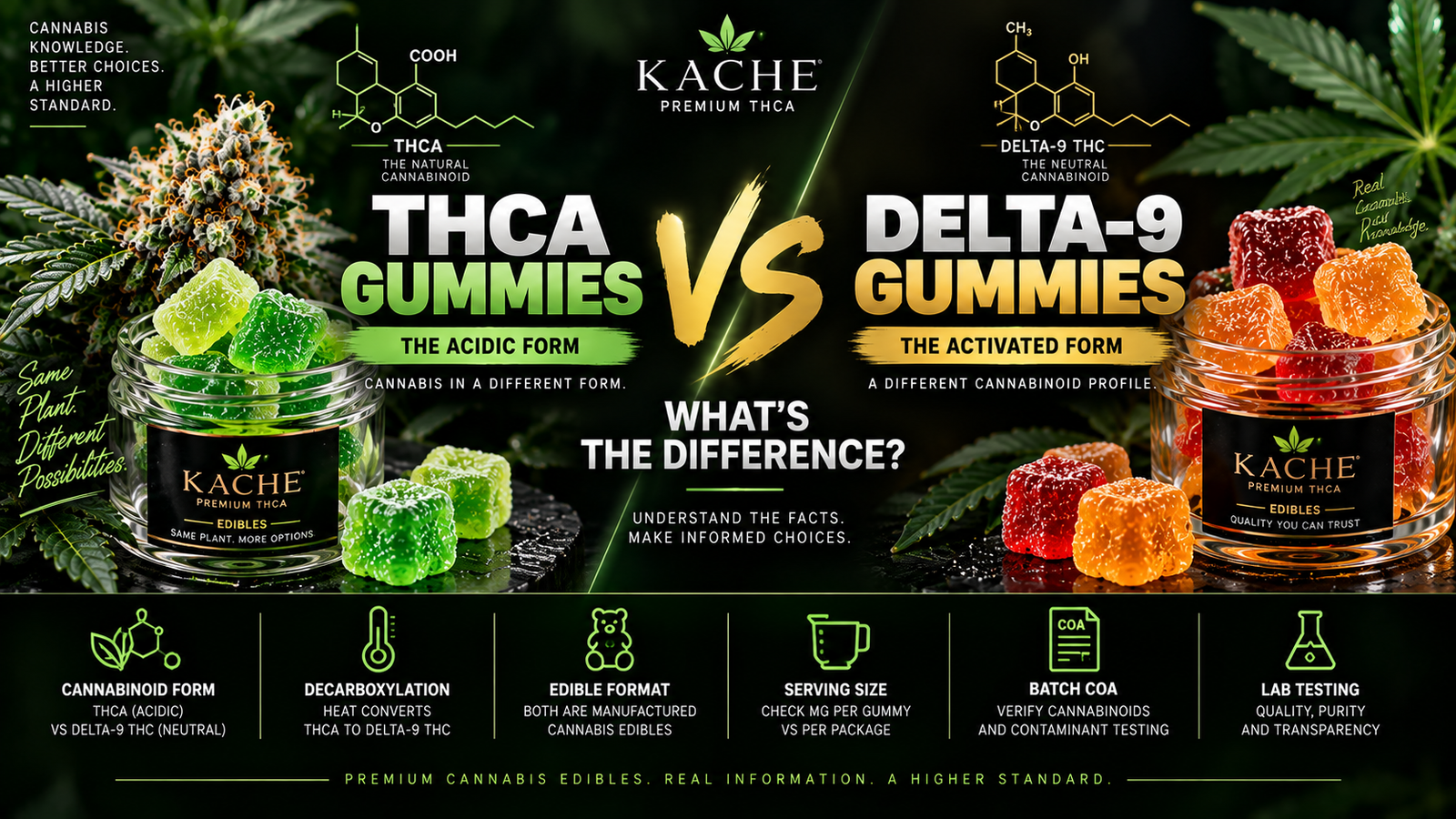
THCA gummies vs Delta-9 gummies may sound like a comparison between two nearly identical cannabis edibles.
Chemically, however, there is an important difference.
THCA (tetrahydrocannabinolic acid) is the acidic precursor to delta-9 THC. Delta-9 THC is the neutral cannabinoid strongly associated with the intoxicating effects of cannabis.
THCA can convert into delta-9 THC through decarboxylation, particularly when sufficient heat is applied.
That distinction is especially important with gummies because gummies are manufactured products. The cannabinoids present in the final edible depend on its formulation and processing—not simply what was present in the cannabis plant before manufacturing.
Therefore, when comparing THCA gummies vs Delta-9 gummies, don’t rely exclusively on the product name.
The ingredient list, cannabinoid amounts, serving information and batch-specific Certificate of Analysis (COA) provide much better information.
This guide explains the major differences.
What Are THCA Gummies?
THCA gummies are edible products marketed around tetrahydrocannabinolic acid (THCA).
THCA naturally occurs in cannabis and is chemically different from delta-9 THC.
In cannabis flower, THCA can be present in substantial concentrations before the flower is heated.
However, gummies are different from raw flower.
They’re manufactured formulations.
That means a product marketed as a THCA gummy could potentially contain:
- THCA
- Delta-9 THC
- Other cannabinoids
- Cannabis extracts
- Various combinations of these ingredients
The exact composition depends on the product.
That’s why we covered the category in detail in our What Are THCA Gummies? Complete Guide.
What Are Delta-9 Gummies?
Delta-9 gummies are edible products formulated with delta-9 tetrahydrocannabinol (delta-9 THC).
Delta-9 THC is one of the best-known cannabinoids associated with cannabis.
Unlike THCA, delta-9 THC does not need to undergo THCA-to-THC decarboxylation before it is already present in its neutral form.
The distinction can be summarized simply:
THCA gummy → marketed around an acidic cannabinoid
Delta-9 gummy → formulated around delta-9 THC
However, commercial formulations can contain multiple cannabinoids, so the product’s laboratory report remains important.
THCA Gummies vs Delta-9 Gummies at a Glance
| Feature | THCA Gummies | Delta-9 Gummies |
|---|---|---|
| Main marketed cannabinoid | THCA | Delta-9 THC |
| Cannabinoid form | Acidic | Neutral |
| THCA may be present | Yes | Possibly |
| Delta-9 THC may be present | Possibly | Yes |
| Manufactured edible | Yes | Yes |
| Intoxication predictable from name alone | No | Delta-9 THC is intoxicating |
| Decarboxylation important | Yes | THC already present |
| Ingredient list important | Yes | Yes |
| Batch COA important | Yes | Yes |
| Laws vary by jurisdiction | Yes | Yes |
The key difference is therefore not the gummy itself.
It’s the cannabinoid chemistry and formulation behind it.
THCA vs Delta-9 THC: The Chemistry
Understanding the molecular difference makes the entire comparison easier.
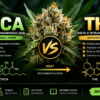
THCA contains a carboxyl group that delta-9 THC does not.
When THCA undergoes decarboxylation, it loses carbon dioxide and becomes delta-9 THC.
In simplified form:
THCA → heat/time → Delta-9 THC + CO₂
Research into cannabinoid decarboxylation demonstrates that temperature and time strongly influence the conversion of acidic cannabinoids into their neutral counterparts.
Read the peer-reviewed cannabinoid decarboxylation study
For a more complete explanation, read our THCA vs THC: What’s the Difference? guide.
Why Decarboxylation Matters
Decarboxylation is one of the most important concepts in cannabis chemistry.
Cannabis naturally contains acidic cannabinoids such as:
THCA
CBDA
CBGA
Heat can transform these compounds into their corresponding neutral cannabinoids.
For THCA:
THCA → Delta-9 THC
This explains why raw cannabis and heated cannabis can have significantly different cannabinoid profiles.
It also explains why edible manufacturing requires careful consideration.
Processing conditions can influence which cannabinoid forms ultimately appear in the finished product.
THCA Gummies vs Delta-9 Gummies: Effects
This is one of the biggest differences consumers want to understand.
Delta-9 THC is psychoactive and is strongly associated with the characteristic intoxication produced by cannabis.
THCA in its unconverted form doesn’t exhibit the same classic intoxicating activity.
However, that does not mean every product labeled “THCA gummies” can automatically be classified as non-intoxicating.
Why?
Because the finished product may contain:
Delta-9 THC
Other psychoactive cannabinoids
or a cannabinoid mixture.
Therefore, statements such as:
“THCA gummies don’t get you high.”
are too simplistic for commercial edible products.
The actual formulation matters.
Why the COA Matters More Than the Front Label
Imagine two products.
The first says:
THCA GUMMIES
The second says:
DELTA-9 GUMMIES
That tells you something about how the products are being marketed.
It does not tell you their complete cannabinoid profiles.
Turn the package over—or follow the laboratory-report link—and you may discover several cannabinoids.
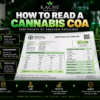
A COA can show measurements for:
- THCA
- Delta-9 THC
- CBD
- CBDA
- CBG
- Other cannabinoids
That information gives you a much more accurate picture.
THCA Gummies vs Delta-9 Gummies: How Edibles Are Formulated
Cannabis gummies aren’t simply cannabis flowers shaped into candy.
They’re manufactured food products.
The general process requires a cannabinoid ingredient to be incorporated into a gummy formulation.
That formulation can also contain:
- Pectin or gelatin
- Sweeteners
- Flavorings
- Acids
- Oils
- Colors
- Other food ingredients
Manufacturers may use different cannabinoid ingredients.
For example, a product might be formulated using an isolate, distillate or broader cannabis-derived concentrate.
That starting ingredient strongly influences the cannabinoid profile of the finished gummy.
THCA Gummies vs Delta-9 Gummies: What Happens After You Eat Them?
Edible cannabinoids follow a different route through the body than inhaled cannabinoids.
After ingestion, compounds must travel through the gastrointestinal tract and undergo absorption and metabolism.
Delta-9 THC undergoes significant first-pass metabolism in the liver, where one important metabolite is 11-hydroxy-THC (11-OH-THC). Research has identified differences between oral and inhaled THC pharmacokinetics, including greater relative formation of 11-OH-THC after oral administration.
Read the cannabinoid pharmacokinetics review
This is one reason edible THC products shouldn’t simply be treated as equivalent to inhaled cannabis.
Do Delta-9 Gummies Take Longer to Work Than Inhaled Cannabis?
Generally, oral THC has a slower onset than inhaled THC.
Inhalation can deliver cannabinoids into circulation relatively quickly.
Oral administration requires gastrointestinal absorption and first-pass metabolism.
Consequently, the effects of an edible containing delta-9 THC may be delayed compared with inhalation.
This delayed onset is important because taking additional servings before the first serving has fully taken effect can result in unexpectedly high exposure.
Public-health guidance therefore emphasizes caution with edible cannabis.
Can THCA Gummies Behave Differently?
Yes, depending on what they actually contain.
A gummy containing primarily unconverted THCA isn’t chemically equivalent to one containing predominantly delta-9 THC.
But a commercial “THCA gummy” could contain other cannabinoids.
That’s why you should not predict a product’s behavior from its name.
Instead, ask:
How much THCA is actually present?
How much delta-9 THC is present?
What other cannabinoids are present?
What does the serving size represent?
Those questions are much more useful.
THCA Gummies vs Delta-9 Gummies: Potency
Potency should be evaluated numerically—not through marketing terms such as:
Extra Strength
Maximum Strength
Ultra
Premium
High Potency
These terms do not replace laboratory measurements.
Look at the cannabinoid amount per serving.
And be careful about the difference between:
mg per gummy
and
mg per package.
Per Gummy vs Per Package
Suppose a container says:
200 MG
There are ten gummies inside.
Does that mean each gummy contains 200 mg?
Or does the entire package contain 200 mg?
Those are radically different products.
If the 200 mg figure represents the entire package and there are ten equal servings, that would correspond to 20 mg per gummy.
This is why serving information matters.
Never infer dosage solely from the largest number printed on the front of a package.
THCA Gummies vs Delta-9 Gummies: Total THC
Another term you may encounter on laboratory reports is:
Total THC.
A commonly used calculation estimates the potential THC contribution from THCA:
Total THC ≈ Delta-9 THC + (THCA × 0.877)
Why multiply THCA by approximately 0.877?
Because THCA loses molecular mass when carbon dioxide is removed during decarboxylation.
This is particularly important when interpreting products containing substantial THCA.
Are THCA Gummies Stronger Than Delta-9 Gummies?
There is no universal answer.
“THCA gummy” and “Delta-9 gummy” are product categories—not standardized potency levels.
One product might contain a small amount of cannabinoids.
Another might contain substantially more.
A product might also contain multiple cannabinoids.
Therefore:
Compare the COAs—not the category names.
THCA Gummies vs Delta-9 Gummies: Live Rosin
Some gummies are formulated using live rosin.
Live rosin is a solventless cannabis concentrate generally produced from fresh-frozen cannabis-derived material.
The process commonly involves:
Fresh frozen → Ice-water hash → Heat + pressure → Live rosin
We explain that entire process here:
What Is Live Rosin? A Complete Guide
A live rosin gummy and a simple delta-9 gummy therefore aren’t necessarily describing the same type of formulation.
“Live rosin” tells you something about the concentrate input.
“Delta-9” tells you about a cannabinoid.
What About Live Resin Gummies?
Live resin is different from live rosin.
Both are associated with fresh cannabis material, but their extraction methods differ.
Live rosin = solventless processing
Live resin = generally solvent extraction
Read the complete comparison here:
Live Rosin vs Live Resin: What’s the Difference?
Again, however, neither term tells you the exact cannabinoid amount in a finished gummy.
Check the COA.
THCA Gummies vs Delta-9 Gummies: Flavor
Cannabinoid type alone doesn’t determine gummy flavor.
Flavor depends heavily on formulation.
Manufacturers can use:
- Natural flavors
- Artificial flavors
- Fruit concentrates
- Acids
- Sweeteners
- Sugar coatings
- Cannabis-derived ingredients
A live rosin gummy may retain different cannabis-derived characteristics from an edible made with a highly refined cannabinoid ingredient.
But this depends on the actual formulation.
THCA Gummies vs Delta-9 Gummies: Pectin or Gelatin
Either product can use pectin or gelatin.
Gelatin is animal-derived.
Pectin is plant-derived.
Consumers seeking plant-based products often look for pectin gummies.
However, pectin alone does not prove that the entire product is vegan.
Always read the complete ingredient list.
Are THCA Gummies Legal?
This question cannot responsibly be answered with:
“Yes, everywhere.”
Cannabis and hemp laws are complicated and continue to change.
Legal treatment can depend on:
- Federal rules
- State rules
- Product formulation
- Delta-9 THC concentration
- Total THC rules
- Age restrictions
- Food-product regulations
- Manufacturing requirements
- Retail restrictions
The same applies to Delta-9 gummies.
Therefore, consumers should verify current laws where they live rather than relying on old blog posts or generic “Farm Bill legal” claims.
Are Hemp-Derived Delta-9 Gummies Legal Everywhere?
No blanket claim should be made.
The 2018 Farm Bill created the federal hemp framework, but states can regulate hemp-derived cannabinoid products differently, and the regulatory landscape continues to evolve.
USDA maintains information on state and tribal hemp programs, but that does not mean every finished cannabinoid edible is automatically permitted for retail sale everywhere.
USDA Hemp Programs and Regulations
For Kache’s SEO content, this is much safer and more accurate than writing “legal in all 50 states.”
FDA and Cannabis Edibles
Another important distinction is between something being sold and something being FDA approved.
Those aren’t the same thing.
FDA has stated that cannabis-derived products are subject to federal food and drug laws and has repeatedly addressed companies making unsupported therapeutic claims about cannabinoid products.
FDA Regulation of Cannabis and Cannabis-Derived Products
Therefore, avoid assuming an ordinary cannabinoid gummy has been evaluated or approved by FDA.
Why Medical Claims Should Be Avoided
You may encounter gummy sellers claiming their products:
Treat anxiety
Eliminate pain
Cure insomnia
Treat depression
or provide other medical outcomes.
Such claims require appropriate evidence and regulatory authorization.
A commercial cannabis blog should not casually repeat them.
The responsible approach is to explain the product’s composition and chemistry without promising medical outcomes.
THCA Gummies vs Delta-9 Gummies: Drug Testing
Consumers should be cautious here.
Standard workplace drug testing may look for metabolites associated with THC exposure rather than simply reading the name on a product package.
Because cannabinoid formulations vary—and because THCA can convert to THC—it is not responsible to guarantee that a product marketed as THCA will not affect a drug test.
If avoiding a positive cannabinoid test is essential, don’t rely on claims such as:
“THCA won’t show up.”
That is not a safe assumption.
Why Storage Matters
Cannabinoid edibles are both cannabis products and food products.
Storage can therefore affect:
Product freshness
Texture
Ingredients
and potentially the stability of cannabinoid components.
Follow the manufacturer’s storage instructions.
More importantly, cannabis gummies should always be stored securely away from children and pets.
Their candy-like appearance makes this especially important.
Child Safety and Cannabis Gummies
Cannabis gummies can closely resemble ordinary candy.
That creates a significant accidental-ingestion risk.
FDA has specifically warned about intoxicating cannabinoid products packaged as gummies, candies and other foods that can appeal to children.
FDA information about intoxicating cannabinoid products
Keep cannabinoid edibles securely stored and clearly separated from ordinary snacks.
How to Compare THCA Gummies vs Delta-9 Gummies
Instead of asking which one is universally “better,” compare actual products using these criteria:
Cannabinoid profile
What does the laboratory report show?
Amount per serving
How many milligrams are present in each gummy?
Ingredients
What else is in the product?
Source material
Is the formulation based on isolate, distillate, live rosin or another extract?
Batch testing
Does the laboratory report correspond to the actual batch?
Contaminant panels
What was tested beyond cannabinoid potency?
Manufacturer transparency
Can you easily determine what you’re buying?
Those factors tell you much more than packaging design.
Kache Premium Gummies
At Kache Premium, our edible range includes cannabis-derived gummy formats designed for customers exploring alternatives to flower and concentrates.
The important part of comparing these products is understanding what the terminology means.
A THCA label refers to a cannabinoid.
Delta-9 refers to another cannabinoid form.
Live rosin describes a concentrate/process category.
Live resin describes another concentrate category.
These terms shouldn’t be treated as synonyms.
You can browse our current selection here:
Explore Kache Premium THCA Edibles
For any individual product, review its current description, ingredients and batch-specific laboratory information.
THCA Gummies vs Delta-9 Gummies: Which Should You Choose?
There isn’t one universal answer.
The right comparison depends on what you’re actually trying to evaluate.
If you’re interested specifically in cannabinoid chemistry, compare THCA and delta-9 THC.
If you’re interested in concentrate inputs, determine whether the gummy uses live rosin, live resin or another ingredient.
If you’re concerned about potency, look at milligrams per serving.
If you’re concerned about product transparency, inspect the COA.
If you’re concerned about dietary ingredients, read the ingredient list.
And if you’re concerned about legality, check the rules that currently apply in your jurisdiction.
The label starts the comparison. It shouldn’t finish it.
Common THCA Gummies vs Delta-9 Gummies Myths
Myth: THCA and delta-9 THC are exactly the same.
False. They’re chemically related but distinct cannabinoid forms.
Myth: Every THCA gummy is non-intoxicating.
Not necessarily. Commercial formulations can contain other cannabinoids, including delta-9 THC.
Myth: Every Delta-9 gummy contains the same amount of THC.
False. Formulations and serving sizes vary.
Myth: Hemp-derived means non-intoxicating.
False. The source classification alone doesn’t establish pharmacological effect.
Myth: A bigger milligram number means a better gummy.
No. Potency is only one product characteristic.
Myth: A QR code proves safety.
No. You need to inspect what the QR code actually links to.
Myth: THCA products can’t affect drug testing.
That should not be assumed.
Myth: Cannabis gummies are FDA approved because they’re sold online.
No. Commercial availability doesn’t equal FDA approval.
Frequently Asked Questions
What is the main difference between THCA gummies and Delta-9 gummies?
THCA gummies are marketed around tetrahydrocannabinolic acid, while Delta-9 gummies contain delta-9 THC as a principal cannabinoid. Actual commercial formulations should be confirmed through their labels and COAs.
Is THCA the same as Delta-9 THC?
No. THCA is an acidic precursor that can convert into delta-9 THC through decarboxylation.
Do THCA gummies get you high?
You cannot determine that reliably from the name alone. Unconverted THCA differs from delta-9 THC, but commercial gummies may contain additional cannabinoids. Review the cannabinoid analysis.
Are Delta-9 gummies intoxicating?
Delta-9 THC is an intoxicating cannabinoid. The amount present and individual factors affect a particular product’s effects.
Are THCA gummies stronger than Delta-9 gummies?
Not inherently. Compare the actual cannabinoid amounts and formulation.
Do THCA gummies contain Delta-9 THC?
Some products may. Check the individual product’s laboratory analysis.
What is a live rosin gummy?
It is a gummy formulated using an ingredient derived from live rosin, a solventless cannabis concentrate generally associated with fresh-frozen starting material.
Are THCA gummies legal everywhere?
No blanket legality assumption should be made. Regulations vary by jurisdiction and product composition.
Can THCA gummies affect a drug test?
It is not responsible to guarantee that a THCA product will not affect cannabis drug testing.
What is the best way to compare gummies?
Review the cannabinoid profile, amount per serving, ingredients, batch information, laboratory testing and applicable local regulations.
Final Thoughts: THCA Gummies vs Delta-9 Gummies
The THCA gummies vs Delta-9 gummies comparison ultimately comes down to understanding what is actually inside the product.
THCA and delta-9 THC are related.
But they aren’t identical.
THCA is an acidic cannabinoid precursor.
Delta-9 THC is the corresponding neutral cannabinoid strongly associated with cannabis intoxication.
And THCA can convert into delta-9 THC through decarboxylation.
Commercial gummies add another layer because they’re manufactured formulations that may contain multiple cannabinoids and cannabis-derived ingredients.
That’s why the smartest comparison isn’t based on whichever words appear largest on the package.
Look at:
Cannabinoid composition.
Milligrams per serving.
Ingredients.
Batch information.
Laboratory results.
Product-specific warnings.
Applicable laws.
Start with our What Are THCA Gummies? Complete Guide for the fundamentals.
Then review THCA vs THC: What’s the Difference? for the chemistry.
If your gummies use concentrate-derived ingredients, our What Is Live Rosin? Complete Guide and Live Rosin vs Live Resin guides explain those terms.
Or browse the Kache Premium THCA Edibles collection.