THCA Diamonds: What Are They? Complete Guide
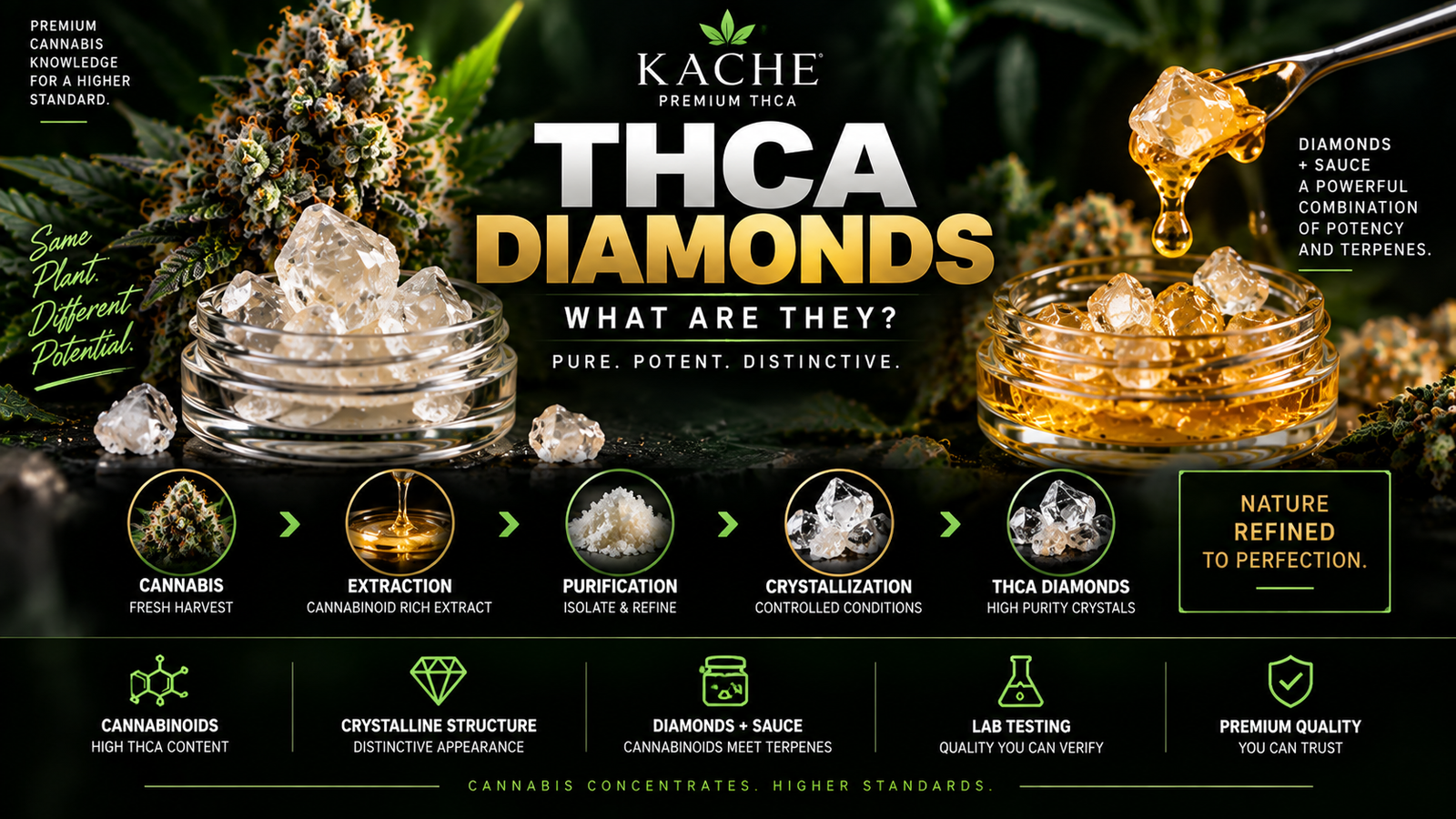
If you’ve explored premium cannabis concentrates, you’ve probably encountered THCA diamonds.
They are difficult to miss.
Instead of resembling ordinary flower, wax or creamy rosin, THCA diamonds form distinctive crystalline structures that can look like translucent or pale crystals.
But what exactly are they?
THCA diamonds are highly concentrated crystalline forms of tetrahydrocannabinolic acid (THCA), the acidic cannabinoid precursor that can convert into delta-9 THC through decarboxylation.
Scientific literature describes commercial THCA diamonds as highly purified crystalline THCA products, although the actual composition of any retail product should always be determined from its laboratory analysis.
In this guide, we’ll explain what THCA diamonds are, why they crystallize, how they compare with live resin and live rosin, what “diamonds and sauce” means, why laboratory testing matters and what you should examine before purchasing a THCA concentrate.
What Are THCA Diamonds?
THCA diamonds are crystalline cannabis concentrates containing highly concentrated THCA.
THCA stands for:
Tetrahydrocannabinolic acid.
It is an acidic cannabinoid naturally produced by cannabis.
Importantly, cannabis doesn’t simply produce large amounts of delta-9 THC directly in fresh flower. THCA is produced and accumulated in glandular trichomes, and it can subsequently convert to THC through decarboxylation.
That’s why THCA appears prominently on laboratory reports for many cannabis flower and concentrate products.
If you need a refresher on this chemistry, read our THCA vs THC: What’s the Difference? guide before continuing.
Why Are They Called THCA “Diamonds”?
The name comes from their appearance.
Under suitable conditions, highly concentrated THCA can form crystalline structures.
These crystals can resemble:
- Small gemstones
- Crushed crystals
- Sugar-like crystals
- Larger translucent formations
Hence the nickname:
THCA diamonds.
However, they aren’t actual diamonds, of course.
They’re cannabinoid crystals.
And appearance alone doesn’t tell you the exact purity or composition of a product.
That requires laboratory analysis.
Is THCA Naturally Found in Cannabis?
Yes.
THCA isn’t something that exists only in concentrates.
It is naturally associated with cannabis.
Research describes THCA-A as the predominant acidic THC precursor produced by cannabis, accumulating in glandular trichomes on flowers and leaves.
This connects THCA diamonds directly back to cannabis flower.
The difference is concentration.
Flower contains THCA alongside many other plant components.
THCA diamonds represent a much more concentrated, purified crystalline form.
For the flower side of the story, read What Is THCA Flower? Complete Beginner’s Guide.
Where Does THCA Come From?
Cannabis produces cannabinoids through a biological pathway.
One important precursor is cannabigerolic acid (CBGA).
Enzymatic activity within the plant can convert CBGA into other acidic cannabinoids, including THCA.
THCA synthase is one of the enzymes involved in this process. Scientific research has isolated and structurally studied THCA synthase from Cannabis sativa.
In simplified terms:
CBGA → THCA
The plant therefore creates THCA biologically.
Extraction and purification processes concentrate what the plant has produced.
What Happens When THCA Is Heated?
This is essential to understanding THCA concentrates.
THCA contains a carboxyl group that can be lost through a process called:
decarboxylation.
Heat accelerates this transformation.
In simplified form:
THCA → Heat → Delta-9 THC + CO₂
Scientific literature confirms that THCA-A decarboxylates into delta-9 THC and that heating can accelerate the reaction.
This is why THCA and delta-9 THC should not be treated as interchangeable terms even though they are chemically related.
Are THCA Diamonds the Same as THC?
No.
This distinction matters.
THCA is not delta-9 THC.
THCA is the acidic precursor.
Delta-9 THC is the corresponding neutral cannabinoid produced when THCA undergoes decarboxylation.
Research examining THCA’s receptor activity has found important pharmacological differences between THCA-A and THC.
So a laboratory report listing THCA should not simply be read as if it said delta-9 THC.
How Are THCA Diamonds Made?
Commercial THCA diamond production involves concentrating THCA and creating conditions that allow it to crystallize.
Different processors can use different extraction, purification and crystallization techniques.
A scientific review discussing THCA diamonds describes a general process involving cannabis extraction, purification and controlled solvent removal that allows isolated THCA to crystallize.
The broad concept can be understood as:
Cannabis → Extraction → Cannabinoid-rich extract → Purification → Crystallization → THCA diamonds
The exact commercial process can vary.
This is an important distinction because the words “THCA diamonds” describe the resulting crystalline cannabinoid product—not necessarily one universal manufacturing procedure.
Why Does THCA Crystallize?
Crystallization occurs when molecules organize into an ordered solid structure under suitable chemical and physical conditions.
You’ve seen crystallization outside cannabis.
Salt forms crystals.
Sugar forms crystals.
Many purified chemical compounds can crystallize.
Cannabinoids can also exhibit crystalline behavior under appropriate conditions.
This is why sufficiently concentrated THCA can separate from other components and form visible crystalline structures.
Are All THCA Diamonds 99% Pure?
No.
This is exactly why you should be careful with marketing claims.
Published literature has described THCA diamonds as products that can achieve very high purity, including products described as exceeding 99% THCA.
But that does not mean every retail product is automatically 99% THCA.
The only responsible way to determine the cannabinoid composition of a specific product is to examine its batch-specific laboratory report.
Don’t infer purity from:
Crystal size.
Don’t infer it from:
Color.
And don’t infer it from the word:
“diamond.”
Check the COA.
What Are THCA Diamonds and Sauce?
This is where the category becomes even more interesting.
Pure cannabinoid crystals can be separated from many of the compounds responsible for cannabis aroma.
Consequently, some products combine THCA crystals with a terpene-rich concentrate commonly referred to as sauce.
This creates:
THCA diamonds + sauce
or simply:
diamonds and sauce.
Scientific literature discussing THCA diamonds notes that highly purified crystals can lack terpenes and flavonoids, leading some commercial products to combine crystals with terpene-containing mixtures.
Visually, the product may appear as solid crystalline pieces sitting within a golden or amber liquid concentrate.
Why Add Sauce to THCA Diamonds?
A highly purified THCA crystal is primarily about cannabinoid concentration.
Cannabis flower, however, contains a much broader chemical mixture.
It can include:
- Cannabinoids
- Terpenes
- Flavonoids
- Waxes
- Lipids
- Other plant-derived compounds
When THCA is extensively purified, many other compounds are separated away.
Adding a terpene-rich fraction changes the overall composition and aromatic characteristics of the finished concentrate.
Therefore:
Pure THCA crystals and diamonds in sauce shouldn’t automatically be treated as identical products.
Check what the manufacturer actually put in the package.
THCA Diamonds vs Live Resin
These two products can be closely connected.
As explained in our Live Rosin vs Live Resin: What’s the Difference? guide, live resin is generally a solvent-extracted concentrate produced from fresh cannabis material. Scientific literature classifies live resin as a hydrocarbon extract derived from fresh cannabis.
THCA diamonds, by contrast, describe a crystalline THCA-rich product.
Therefore:
| Feature | THCA Diamonds | Live Resin |
|---|---|---|
| Concentrate | Yes | Yes |
| Main defining characteristic | THCA crystals | Fresh-material extract |
| Crystalline structure | Usually | Not required |
| THCA can be present | Yes | Yes |
| Terpenes naturally abundant in final fraction | Not necessarily | Often retained |
| Solvent extraction possible | Yes | Typically |
| Can appear in sauce | Yes | Can be sauce-like |
| Laboratory testing important | Yes | Yes |
This means THCA diamonds and live resin aren’t necessarily opposing categories.
A concentrate processing workflow can produce crystalline THCA alongside terpene-rich fractions.
THCA Diamonds vs Live Rosin
This comparison is more distinct.
Live rosin is defined largely by its solventless processing method.
As explained in our What Is Live Rosin? A Complete Guide, live rosin commonly begins with fresh-frozen cannabis, followed by mechanical trichome separation and pressing.
THCA diamonds focus instead on cannabinoid crystallization and concentration.
| Feature | THCA Diamonds | Live Rosin |
|---|---|---|
| Highly crystalline | Usually | Usually not |
| Solventless by definition | No | Yes |
| Concentrated THCA | Typically | Can contain substantial THCA |
| Terpene-rich | Depends on product | Can be |
| Fresh-frozen required | No universal requirement | Commonly |
| Heat-and-pressure pressing defines product | No | Yes |
Neither category is automatically “better.”
They’re different concentrate formats.
THCA Diamonds vs Sugar Wax
The names describe very different physical structures.
THCA diamonds are crystalline.
Sugar wax generally has a softer, grainy or sugar-like consistency.
Both can contain significant amounts of THCA.
However, texture alone doesn’t tell you cannabinoid concentration.
This is particularly relevant because the Kache Premium concentrates collection includes different textures and formats, including Kache Premium Diamonds and Kache Premium Sugar Wax.
Explore Kache Premium THCA Concentrates
THCA Diamonds vs Badder
Badder typically describes a concentrate with a soft, whipped or batter-like consistency.
THCA diamonds are crystalline.
Again:
Badder = texture/style
Diamonds = crystalline cannabinoid format
A concentrate’s consistency doesn’t automatically establish its cannabinoid concentration, purity or quality.
That’s why the COA remains important.
Are THCA Diamonds Solventless?
Not necessarily.
This is a crucial difference from live rosin.
Commercial THCA diamonds may be produced using solvent-based extraction and purification processes.
Scientific literature discussing THCA diamonds specifically describes methods involving cold extraction, commonly using butane, followed by purification and crystallization.
Therefore, don’t assume:
“THCA diamonds = solventless.”
If solventless processing matters to you, verify the production method.
For a specifically solventless concentrate category, return to our What Is Live Rosin? guide.
THCA Diamonds and Residual Solvents
When solvents are used during extraction or purification, residual-solvent testing becomes relevant.
Professional processing is designed to remove extraction solvents to appropriate specifications.
However, consumers shouldn’t have to guess.
The product’s laboratory documentation should tell you what was tested.
This is one reason a Certificate of Analysis is especially useful when evaluating concentrates.
What Do THCA Diamonds Look Like?
Appearance varies.
THCA crystals may appear:
- Clear
- Translucent
- White
- Off-white
- Pale yellow
- Crystal-like
- Chunky
- Granular
Diamonds in sauce can look substantially different because the crystals are surrounded by a liquid or semi-liquid concentrate.
But appearance should never substitute for analytical testing.
A crystal that looks extremely clear isn’t automatically more pure than one with slight coloration.
Does Crystal Size Determine Quality?
No.
A huge crystal makes an impressive photograph.
It doesn’t automatically make a better concentrate.
Crystal size can be influenced by crystallization conditions and processing.
What consumers should care about more is:
Composition
Purity
Contaminant testing
Product freshness
Storage
Manufacturer transparency
A giant diamond without reliable laboratory information is still an unknown product.
Do THCA Diamonds Have Terpenes?
Pure THCA crystals themselves are not expected to reproduce the complex terpene profile of whole cannabis flower.
Highly purified THCA products may contain little of the terpene fraction remaining from the original material.
That’s why diamonds are sometimes combined with terpene-rich sauce.
So when shopping, determine whether the product is:
THCA crystals
or
THCA diamonds in sauce.
Those aren’t necessarily the same experience or chemical composition.
Are THCA Diamonds Strong?
THCA diamonds are highly concentrated cannabinoid products.
Published scientific literature has described products marketed as THCA diamonds as containing extremely high THCA purity.
However, “strong” is vague.
The better question is:
What does the laboratory report show?
Look at the measured cannabinoid concentrations rather than relying on marketing language.
Remember also that THCA can convert into delta-9 THC through decarboxylation.
Are THCA Diamonds Intoxicating?
THCA itself differs pharmacologically from delta-9 THC and does not produce the same classic intoxicating profile in its unconverted state. Research has demonstrated markedly different CB1 receptor activity between THCA-A and THC.
However, THCA can convert into delta-9 THC when heated.
Therefore, how a THCA-containing product is processed or used materially affects the cannabinoid form involved.
This is why saying simply “THCA doesn’t get you high” can be misleading when discussing products that may subsequently be heated.
What Is Total THC?
You may see Total THC on cannabis laboratory reports.
A commonly used calculation accounts for the potential conversion of THCA into THC:
Total THC ≈ delta-9 THC + (THCA × 0.877)
The conversion factor reflects the difference in molecular mass after THCA loses carbon dioxide during decarboxylation.
This is particularly relevant for high-THCA products because a product can contain relatively little measured delta-9 THC while containing substantial THCA.
How to Read a THCA Diamonds COA
Before buying THCA diamonds, inspect the batch-specific Certificate of Analysis.
Start with cannabinoid potency.
Look for:
THCA
Delta-9 THC
CBD
CBDA
CBG
and any other reported cannabinoids.
Then check whether appropriate contaminant testing was performed.
Depending on the product and testing program, this may include:
- Residual solvents
- Pesticides
- Heavy metals
- Microbial contaminants
- Mycotoxins
Don’t assume that a potency report automatically means all of those tests were completed.
What Makes High-Quality THCA Diamonds?
Quality can’t be reduced to one characteristic.
Cannabinoid Analysis
Look at the actual laboratory measurement.
Appropriate Testing
Determine which contaminant panels were performed.
Transparency
The batch information should correspond to the product you’re purchasing.
Appearance
Crystals should be evaluated alongside—not instead of—laboratory information.
Storage
Cannabinoids can change with heat, light, oxygen and time.
Sauce Quality
For diamonds in sauce, the accompanying concentrate matters too.
The finished product is the combination of both components.
Why Storage Matters
THCA isn’t infinitely stable.
Research shows that THCA can gradually decarboxylate during storage and that heat accelerates conversion to THC.
For that reason, concentrates should be stored according to the manufacturer’s product-specific instructions.
Avoid assuming that every cannabis concentrate requires identical storage.
Packaging, formulation and intended shelf conditions can differ.
Kache Premium Diamonds
Our concentrate collection includes Kache Premium Diamonds alongside live rosin, badder, sugar wax and other concentrate formats.
The reason for offering different concentrate styles is straightforward:
They represent different approaches to cannabis resin.
A customer interested in solventless processing may gravitate toward live rosin.
Someone researching crystalline cannabinoid concentrates may instead be interested in diamonds.
The important thing is understanding the difference rather than assuming every concentrate is essentially the same.
Explore Kache Premium THCA Concentrates
THCA Diamonds vs Other Concentrates
Here’s the broader picture:
| Product | Defining Characteristic | Typical Texture | Solventless by Definition? |
|---|---|---|---|
| THCA Diamonds | Crystalline THCA | Crystal | No |
| Live Rosin | Fresh-frozen + solventless processing | Varies | Yes |
| Live Resin | Fresh material + solvent extraction | Sauce/badder/etc. | No |
| Sugar Wax | Texture/style | Grainy/sugary | No |
| Badder | Texture/style | Soft/whipped | No |
| Ice-Water Hash | Mechanical trichome separation | Granular/resinous | Yes |
This is why learning concentrate terminology is so valuable.
Two products can look similar while being manufactured very differently.
Common Myths About THCA Diamonds
Myth: THCA diamonds are literal diamonds.
No. They’re cannabinoid crystals.
Myth: Every THCA diamond is 99% pure.
No. Some highly purified products may reach very high THCA concentrations, but the specific product’s COA determines its actual composition.
Myth: THCA diamonds are automatically solventless.
No. Solvent-based extraction and purification can be used to produce crystalline THCA.
Myth: Bigger crystals mean better quality.
Not necessarily. Crystal size isn’t a substitute for laboratory testing.
Myth: THCA and THC are exactly the same.
No. THCA is the acidic precursor to delta-9 THC.
Myth: Diamonds always contain lots of terpenes.
Highly purified THCA crystals can contain little terpene material. Some products therefore combine diamonds with terpene-rich sauce.
Myth: A clear concentrate is automatically clean.
No. Appearance cannot determine pesticide, heavy-metal, microbial or residual-solvent status.
Frequently Asked Questions About THCA Diamonds
What are THCA diamonds?
THCA diamonds are highly concentrated crystalline forms of tetrahydrocannabinolic acid, an acidic cannabinoid naturally produced by cannabis.
Why are THCA diamonds called diamonds?
The name refers to their crystalline, gemstone-like appearance.
Are THCA diamonds pure THCA?
They can contain very high concentrations of THCA, but purity varies. Check the batch-specific laboratory report rather than assuming a percentage.
Are THCA diamonds the same as THC diamonds?
Terminology can be inconsistent. The laboratory analysis is more reliable than informal product naming.
Are THCA diamonds the same as live resin?
No. THCA diamonds describe crystalline THCA, while live resin describes a solvent-extracted concentrate produced from fresh cannabis material. However, crystalline THCA and terpene-rich sauce can occur within related concentrate processing workflows.
Are THCA diamonds the same as live rosin?
No. Live rosin is defined by fresh-frozen starting material and solventless processing. THCA diamonds are defined primarily by their crystalline THCA-rich structure.
What are diamonds and sauce?
Diamonds and sauce combines THCA crystals with a liquid or semi-liquid concentrate that may contain terpenes and other cannabinoids.
Do THCA diamonds contain terpenes?
Highly purified THCA crystals may contain relatively little terpene material. Diamonds-in-sauce products can contain a terpene-rich fraction.
Are THCA diamonds solventless?
Not necessarily. Some manufacturing methods use solvents during extraction and purification.
How do I know what’s actually in THCA diamonds?
Review the batch-specific Certificate of Analysis from a qualified laboratory.
Final Thoughts: What Are THCA Diamonds?
THCA diamonds are one of the most visually distinctive forms of cannabis concentrate.
But behind their gemstone-like appearance is relatively straightforward chemistry.
Cannabis naturally produces THCA.
That THCA can be extracted, concentrated, purified and—under suitable conditions—formed into crystals.
The resulting concentrate may contain extremely high concentrations of THCA, although the exact composition of any product should always be confirmed through laboratory testing.
Some diamonds are sold primarily as crystals.
Others are combined with terpene-rich sauce.
And unlike live rosin, THCA diamonds shouldn’t automatically be assumed to be solventless.
Understanding those distinctions makes it much easier to compare concentrates based on what they actually are rather than what their marketing names imply.
Continue learning with our What Is Live Rosin? Complete Guide, then compare extraction methods in Live Rosin vs Live Resin: What’s the Difference?
Or browse the Kache Premium THCA Concentrates collection to see the different concentrate formats available.