Live Rosin vs Live Resin: What’s the Difference?
Live rosin vs live resin is one of the easiest cannabis comparisons to misunderstand.
Their names differ by only one letter.
Both are cannabis concentrates. Both are commonly associated with fresh-frozen cannabis. Both can contain cannabinoids and aromatic compounds from the original plant.
However, there is one major difference:
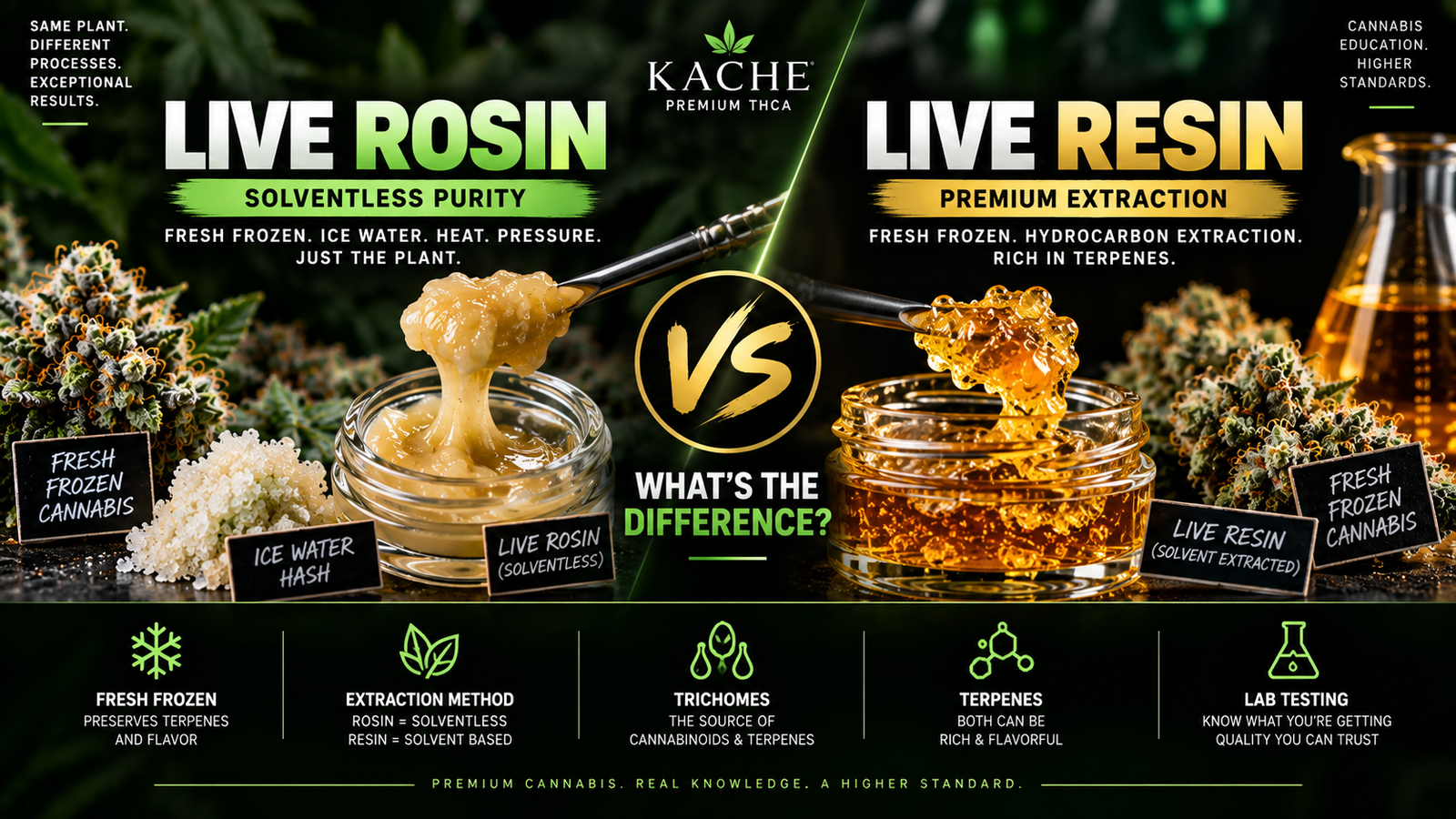
Live rosin is produced using solventless mechanical processing, while live resin is generally produced using solvent-based extraction.
That difference affects how each concentrate is manufactured and helps explain their different places within the concentrate market.
Scientific literature describes live resin as a hydrocarbon extract from fresh cannabis material, while rosin is produced through pressure and heat.
So although these products sound almost identical, they aren’t interchangeable.
In this complete Kache Premium guide, we’ll compare live rosin vs live resin, including their starting material, extraction methods, trichomes, solvents, appearance, cannabinoids, terpenes, laboratory testing, price and overall quality.
What Is Live Rosin?
Live rosin is generally a solventless cannabis concentrate derived from fresh-frozen cannabis.
The process commonly begins by preserving freshly harvested cannabis through freezing.
Trichome-rich resin is then mechanically separated, often through an ice-water process, to create hash.
The resulting hash can then be pressed using controlled heat and pressure to release the resinous concentrate.
In simplified form:
Fresh cannabis → Fresh frozen → Ice-water hash → Heat + pressure → Live rosin
Industry terminology calls this process “solventless” because it does not use organic extraction solvents such as butane or propane. Technically, water itself is a solvent in chemistry, but “solventless” is the established industry term for these mechanical/water-based processes.
For the complete explanation, start with our What Is Live Rosin? A Complete Guide.
What Is Live Resin?
Live resin is also a cannabis concentrate.
However, its extraction process differs fundamentally from live rosin.
Live resin generally begins with fresh or fresh-frozen cannabis rather than traditionally dried and cured flower.
The plant material is then subjected to a solvent-based extraction process.
Hydrocarbons such as butane or propane may be used in commercial extraction systems.
Scientific literature describes live resin as a hydrocarbon extract made from fresh cannabis plant material.
After extraction, downstream processing removes the extraction solvent according to the process being used.
In simplified form:
Fresh cannabis → Fresh frozen → Hydrocarbon extraction → Solvent removal/processing → Live resin
Therefore, the most important distinction is easy to remember:
Live ROSIN = solventless
Live RESIN = solvent-based
Live Rosin vs Live Resin at a Glance
| Feature | Live Rosin | Live Resin |
|---|---|---|
| Cannabis concentrate | Yes | Yes |
| Commonly uses fresh-frozen material | Yes | Yes |
| “Live” product | Yes | Yes |
| Mechanical separation | Yes | No, primarily solvent extraction |
| Ice-water hash commonly involved | Yes | No |
| Heat + pressure pressing | Yes | No |
| Hydrocarbon extraction | No | Commonly |
| Solventless | Yes | No |
| Can contain THCA | Yes | Yes |
| Can contain delta-9 THC | Yes | Yes |
| Terpenes can be present | Yes | Yes |
| Lab testing important | Yes | Yes |
| Quality depends on starting material | Yes | Yes |
The table reveals something important.
The “live” part is actually one of their similarities.
The extraction method creates the major difference.
What Does “Live” Mean in Cannabis Concentrates?
The term live generally refers to the condition of the cannabis starting material.
Traditional cannabis processing usually involves drying and curing harvested flower.
Live concentrates instead use cannabis preserved soon after harvest, commonly through freezing.
Why?
Because harvested cannabis continues to change after it leaves the plant.
Drying, storage, heat, oxygen and other post-harvest conditions can affect cannabinoids and volatile compounds.
A scientific review of post-harvest cannabis operations confirms that drying, curing, packaging and storage can affect cannabinoid profiles and product quality.
This helps explain why processors use fresh-frozen material when producing live concentrates.
Live Rosin vs Live Resin: The Extraction Difference
This is the heart of the comparison.
Live Rosin Extraction
Live rosin relies primarily on physical separation.
The trichomes are separated from the cannabis material, commonly using ice water.
The collected hash is dried and then pressed using heat and pressure.
Research on cannabis concentrates describes solventless processing as cold-water agitation followed by filtration and pressing between heated plates.
Live Resin Extraction
Live resin takes another approach.
Instead of mechanically separating trichomes and pressing hash, solvents are used to extract compounds from fresh cannabis material.
Hydrocarbons commonly associated with this process include:
- Butane
- Propane
- Hydrocarbon blends
The extraction solvent must subsequently be removed from the concentrate through controlled processing.
This difference is fundamental.
Why Are Butane and Propane Used?
Cannabinoids are largely nonpolar compounds.
Hydrocarbon solvents can therefore effectively extract resin components from cannabis.
Butane is commonly used in hydrocarbon cannabis extraction, while propane and hydrocarbon mixtures may also be employed. Scientific literature notes that hydrocarbon extraction can recover cannabinoids, terpenes, waxes and lipids, followed by additional refining and solvent-removal steps.
This chemistry helps explain why hydrocarbon extraction became an important commercial method.
However, the presence of an extraction solvent also creates additional processing and testing considerations.
Does Live Resin Still Contain Butane?
A properly manufactured commercial product is processed to remove the extraction solvent to applicable specifications.
But consumers shouldn’t simply assume this has happened correctly.
This is where laboratory testing becomes particularly important.
Depending on jurisdiction and testing requirements, concentrate COAs may include residual-solvent testing.
If you’re evaluating a solvent-extracted concentrate, look at the actual laboratory report rather than relying solely on packaging claims.
Is Live Rosin Completely Chemical-Free?
“Chemical-free” isn’t scientifically meaningful.
Everything around us consists of chemicals—including water, cannabinoids and terpenes.
The accurate claim is:
Traditional live rosin production doesn’t use organic extraction solvents such as butane or propane.
That is what solventless means in the cannabis industry.
It doesn’t mean the finished product contains no chemicals.
Live Rosin vs Live Resin: Starting Material
Here’s where the two concentrates become similar again.
Both commonly use fresh-frozen cannabis.
That is what makes them “live.”
The plant is harvested and preserved through freezing rather than going through the complete traditional drying-and-curing process before extraction.
Therefore:
Live rosin and live resin can start with very similar cannabis material and end up as very different concentrates because of what happens next.
Why Starting Material Matters
Extraction cannot magically create excellent resin from poor-quality cannabis.
Genetics influence:
- Cannabinoid expression
- Terpene expression
- Trichome development
- Plant structure
- Resin production
Cultivation matters too.
Environmental conditions, plant health and harvest maturity all affect the cannabis entering the extraction process.
This is why our concentrates content connects directly to our cultivation content.
If you’d like to understand where the process begins, read How Cannabis Is Grown: Our Complete Seed-to-Harvest Process.
Live Rosin vs Live Resin: Trichomes
Trichomes are central to both products.
Cannabis glandular trichomes are resin-producing structures associated with the plant’s cannabinoids and many aromatic compounds.
Live rosin processing attempts to physically isolate trichome-rich material before pressing it.
Live resin uses a solvent to extract compounds from the cannabis material.
So both approaches target valuable resin components, but they reach them differently.
Think of it this way:
Rosin mechanically separates and presses the resin.
Resin chemically extracts compounds using a solvent.
Live Rosin vs Live Resin: Terpenes
Terpenes contribute heavily to cannabis aroma.
They are volatile compounds, meaning processing and storage conditions can influence them.
Both live rosin and live resin are associated with processes designed around fresh cannabis material.
However, you should be cautious about broad claims such as:
“Live rosin always has more terpenes.”
or
“Live resin always tastes stronger.”
Neither statement is universally true.
Extraction strategy, starting genetics, processing temperature, storage and other variables can influence the final chemical profile. A recent 2026 review emphasizes that extraction method, temperature, time and pressure can affect cannabinoid and terpene preservation and that no single extraction method is universally optimal.
Read the 2026 review of cannabis extraction methods on PubMed
Which Preserves More Terpenes?
There isn’t a scientifically defensible universal winner.
Live resin extraction is specifically associated with fresh plant material and terpene preservation.
Live rosin can also retain aromatic compounds because fresh-frozen material is processed without organic extraction solvents.
But actual terpene concentration depends on the individual product.
The better approach is to examine:
Starting genetics + extraction process + storage + laboratory data
rather than assuming one category always contains more terpenes.
Live Rosin vs Live Resin: Appearance
Both concentrates can vary dramatically in appearance.
Live Rosin May Appear:
- Pale cream
- Yellow
- Golden
- Amber
- Glossy
- Batter-like
- Sauce-like
Live Resin May Appear:
- Yellow
- Gold
- Amber
- Sauce-like
- Sugar-like
- Badder-like
Texture doesn’t automatically identify the extraction method.
That’s important because names such as:
badder, sauce, sugar and wax
often describe consistency or product style rather than telling you the entire extraction history.
Why Concentrates Have Different Textures
Concentrates are complex mixtures.
They can contain varying proportions of:
- Cannabinoids
- Terpenes
- Waxes
- Lipids
- Other plant-derived compounds
Processing conditions influence how these components organize.
Post-processing can further change consistency.
Therefore, two live rosin products can look different from one another.
The same applies to two live resin products.
Appearance is useful context—not proof of composition.
Live Rosin vs Live Resin: Cannabinoids
Both products can contain multiple cannabinoids.
Depending on the starting material and processing, laboratory analysis may detect:
- THCA
- Delta-9 THC
- CBDA
- CBD
- CBG
- CBGA
- Other cannabinoids
Cannabinoid composition can also be affected by temperature.
A recent review notes that higher extraction temperatures can promote decarboxylation of acidic cannabinoids and contribute to terpene loss.
That is why controlled processing matters.
Can Live Rosin Contain THCA?
Yes.
Live rosin can contain substantial THCA depending on its starting material and processing.
However, don’t assume the concentration.
Check the COA.
Can Live Resin Contain THCA?
Yes.
Live resin can also contain substantial THCA.
Again, the exact cannabinoid profile should come from laboratory analysis rather than the product name.
If you’re unsure why both THCA and THC can appear on a concentrate COA, read our THCA vs THC: What’s the Difference? guide.
Is Live Rosin Stronger Than Live Resin?
Not automatically.
The extraction method alone doesn’t determine potency.
Cannabinoid concentration depends on:
- Starting material
- Genetics
- Extraction efficiency
- Processing
- Product formulation
- Storage
Both are concentrated cannabis products and can contain substantially higher cannabinoid concentrations than ordinary flower.
Research on cannabis concentrates reports that concentrates as a category can reach very high THC concentrations, although individual products vary widely.
The laboratory report is the appropriate way to compare actual products.
Live Rosin vs Live Resin: Which Is More Natural?
“Natural” is a marketing term without a precise definition here.
Live rosin uses mechanical separation, water, heat and pressure rather than hydrocarbon extraction.
Some consumers therefore prefer describing it as less processed.
But “more natural” doesn’t automatically mean safer, cleaner or higher quality.
Both categories require professional production and appropriate testing.
Does Solventless Mean Safer?
Not automatically.
This deserves repeating because it is one of the biggest misconceptions surrounding rosin.
Solventless means organic extraction solvents weren’t used.
It does not guarantee the absence of:
- Pesticide residues
- Heavy metals
- Microorganisms
- Mycotoxins
- Other contaminants
Scientific reviews of cannabis concentrates have documented contaminant concerns across concentrate products and emphasize the importance of regulated production and testing.
Therefore:
Extraction method and product safety are related considerations, but they aren’t the same thing.
Why Laboratory Testing Matters
A Certificate of Analysis can provide objective information about what is actually in a concentrate.
For both live rosin and live resin, begin with the cannabinoid panel.
Look for measurements such as:
THCA
Delta-9 THC
CBD
CBDA
CBG
Then determine which contaminant panels were performed.
Depending on the product and jurisdiction, testing may include:
- Pesticides
- Heavy metals
- Microbial contaminants
- Mycotoxins
For live resin and other solvent-extracted concentrates, residual-solvent testing is particularly relevant.
We’ll explain these reports in detail in Blog #10: How to Read a Cannabis Certificate of Analysis (COA).
Live Rosin vs Live Resin: Which Costs More?
Live rosin often occupies a premium price tier.
Why?
The solventless process can be labor intensive.
Producing live hash rosin may involve:
High-quality cannabis → Fresh freezing → Ice-water separation → Hash collection → Drying → Pressing → Post-processing → Testing
Not every gram of starting flower becomes premium hash rosin.
The quality of the resin and efficiency of separation therefore matter considerably.
Live resin extraction can be more scalable in commercial environments, although it requires specialized extraction and safety equipment.
So differences in production economics can contribute to different retail prices.
Does More Expensive Mean Better?
No.
Price isn’t laboratory evidence.
An expensive jar can still be poorly stored, old or derived from mediocre starting material.
Likewise, an efficiently produced product can offer excellent quality without occupying the highest price tier.
Instead of judging solely by price, evaluate:
Genetics → Starting material → Extraction → Laboratory testing → Storage → Freshness
Live Rosin vs Live Resin: Which Has Better Flavor?
There is no universal winner.
Flavor and aroma depend heavily on the chemical profile of the individual concentrate.
Factors include:
- Genetics
- Terpenes
- Starting material
- Extraction conditions
- Post-processing
- Storage
- Product age
Both live rosin and live resin can preserve characteristics associated with fresh cannabis material.
Therefore, “better” becomes product-specific and subjective.
Live Rosin vs Live Resin: Which Is Better?
This depends on what you value.
If your priority is a concentrate produced without hydrocarbon extraction solvents, live rosin has a clear distinction.
If you’re comparing actual cannabinoid or terpene concentrations, you need laboratory data.
If you’re comparing flavor, the answer depends on the individual cultivar and product.
If you’re comparing safety, look at production standards and testing—not simply whether the label says rosin or resin.
The useful question isn’t:
Which category is universally better?
It is:
Which specific product has the quality, composition, extraction method and testing documentation I’m looking for?
How to Choose Between Live Rosin and Live Resin
When comparing products, consider six things.
1. Extraction Method
Decide whether solventless processing matters to you.
2. Starting Material
Look for transparent information about the cannabis used.
3. Cannabinoid Profile
Review the laboratory measurements instead of assuming potency.
4. Testing
Check exactly which analytical panels were completed.
5. Freshness and Storage
Concentrates can change with heat, oxygen, light and time.
6. Brand Transparency
Look for clear descriptions rather than vague claims such as “pure,” “clean” or “premium.”
Kache Premium Live Rosin
For customers specifically interested in solventless concentrates, our concentrate collection includes Kache Premium Live Rosin and Ronin Live Hash Rosin alongside other concentrate formats.
The important distinction is not simply the product name.
It is understanding how that product was made.
Explore the collection here:
Kache Premium THCA Concentrates
Our goal with this educational series is to make concentrate terminology easier to understand before you compare individual products.
Live Rosin vs Live Resin vs Flower
Here’s the broader picture:
| Feature | Live Rosin | Live Resin | Flower |
|---|---|---|---|
| Cannabis product | Yes | Yes | Yes |
| Concentrate | Yes | Yes | No |
| Fresh-frozen commonly used | Yes | Yes | No |
| Solventless processing | Yes | No | Not applicable |
| Hydrocarbon extraction | No | Commonly | No |
| Trichomes important | Yes | Yes | Yes |
| Cannabinoids present | Yes | Yes | Yes |
| Laboratory testing useful | Yes | Yes | Yes |
If you want to understand the flower side of the equation first, read What Is THCA Flower? Complete Beginner’s Guide.
Common Live Rosin vs Live Resin Myths
Myth 1: Live rosin and live resin are the same thing.
False. They commonly share fresh-frozen starting material but use different extraction methods.
Myth 2: Live resin is solventless.
False. Live resin is generally produced using solvent extraction, commonly hydrocarbons.
Myth 3: Live rosin contains no chemicals.
Everything consists of chemicals. The accurate distinction is that traditional live rosin doesn’t use organic extraction solvents such as butane or propane.
Myth 4: Live rosin always contains more terpenes.
Not necessarily. Actual terpene profiles depend on the starting material, processing and storage.
Myth 5: Live resin always contains dangerous residual solvents.
Not necessarily. Professionally manufactured products undergo solvent-removal processes and may be tested for residual solvents. The COA is more useful than assumptions.
Myth 6: Solventless automatically means contaminant-free.
False. Pesticides, heavy metals and other contaminants are separate considerations.
Myth 7: Live rosin is always stronger.
False. Potency must be determined from the individual product’s laboratory analysis.
Frequently Asked Questions About Live Rosin vs Live Resin
What is the main difference between live rosin and live resin?
The main difference is extraction. Live rosin uses solventless mechanical processing, commonly involving ice-water hash followed by heat and pressure. Live resin generally uses solvent-based extraction, commonly involving hydrocarbons.
Are live rosin and live resin made from fresh-frozen cannabis?
Both commonly use fresh or fresh-frozen cannabis material, which is why both use the word “live.”
Is live rosin solventless?
Yes. In standard cannabis-industry terminology, live rosin is a solventless concentrate.
Is live resin solventless?
No. Live resin is generally a solvent-extracted concentrate.
Does live resin contain butane?
Butane may be used during hydrocarbon extraction, but commercial processing is designed to remove the extraction solvent. Product-specific residual-solvent testing should be checked where applicable.
Does live rosin contain THCA?
It can. The exact cannabinoid profile depends on the starting material and processing and should be verified with laboratory results.
Does live resin contain THCA?
Yes, live resin can also contain THCA. Again, the actual amount varies.
Is live rosin stronger than live resin?
Not inherently. Compare the cannabinoid analysis of the individual products.
Is live rosin better than live resin?
Neither is universally better. Live rosin offers solventless processing, while live resin uses solvent extraction. Quality depends on starting material, processing, testing, storage and the individual product.
Why is live rosin often more expensive?
Producing premium live rosin can involve labor-intensive trichome separation, hash preparation, pressing and relatively selective yields from high-quality starting material.
Final Thoughts: Live Rosin vs Live Resin
The live rosin vs live resin comparison becomes surprisingly simple once you understand the terminology.
Both can begin with fresh-frozen cannabis.
Both are concentrates.
Both can contain cannabinoids and aromatic compounds from the plant.
But their extraction methods separate them.
Live rosin = fresh-frozen cannabis + solventless processing
Live resin = fresh-frozen cannabis + solvent-based extraction
That distinction matters—but it isn’t the only thing that determines quality.
Genetics matter.
Cultivation matters.
Trichome development matters.
Extraction conditions matter.
Laboratory testing matters.
And storage matters.
That’s why at Kache Premium we recommend looking beyond a single word on the package.
If you’re new to solventless concentrates, begin with What Is Live Rosin? A Complete Guide.
If you want to understand the plant behind the concentrate, read How Cannabis Is Grown: Our Complete Seed-to-Harvest Process.
For cannabinoid chemistry, explore THCA vs THC: What’s the Difference?
And when you’re ready to browse concentrate formats, visit the Kache Premium THCA Concentrates collection.
For scientific authority, the strongest outbound source for this article is this peer-reviewed clinical framework, which explicitly classifies live resin as a hydrocarbon extract from fresh cannabis and rosin as a pressure-and-heat solventless extract.
Read the peer-reviewed Cannabis Product Quality & Safety framework