
What Is Live Rosin? A Complete Guide to Solventless Cannabis Concentrates
What is live rosin?
If you have been exploring premium cannabis concentrates, you have probably encountered terms such as live rosin, live resin, hash rosin, badder, diamonds and sugar wax.
They can sound similar, but they do not necessarily describe the same products or production methods.
Live rosin is particularly distinctive.
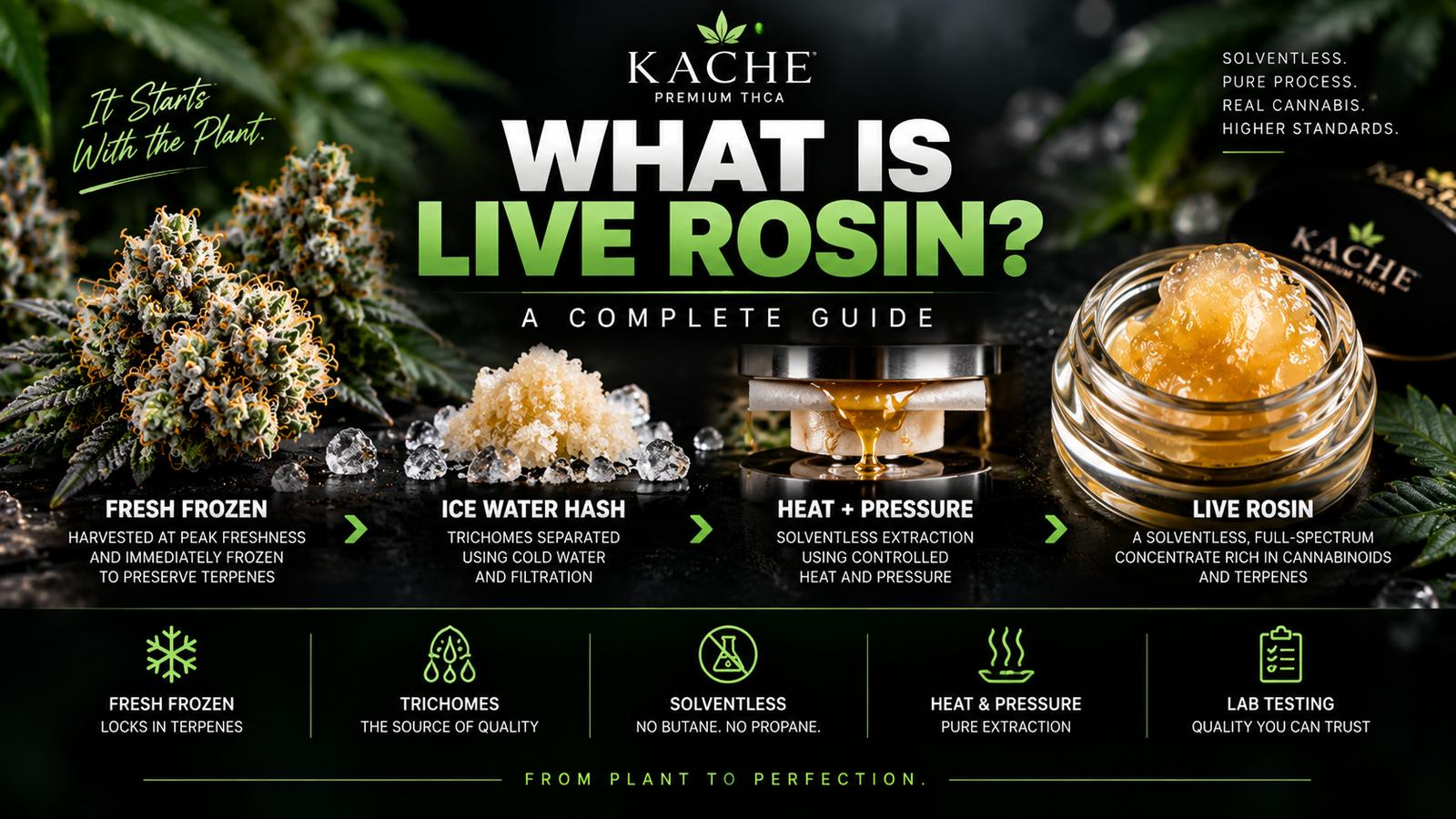
In general, live rosin is a solventless cannabis concentrate produced from fresh-frozen cannabis, commonly by first separating trichomes into ice-water hash and then pressing that hash using controlled heat and pressure.
No butane or propane is required for the extraction.
And the word “live” matters just as much as the word “rosin.”
It tells you something important about the starting material.
In this complete guide, we’ll explain what live rosin is, what makes it “live,” how it differs from ordinary rosin and live resin, why trichomes are so important, what quality live rosin can look like, how to read its laboratory report and why solventless concentrates have become such an important category.
What Is Live Rosin?
Let’s start with the simplest definition.
Live rosin is a solventless cannabis concentrate made using fresh-frozen cannabis as its starting material.
The harvested cannabis is frozen rather than going through the traditional drying and curing process before extraction.
The resin-rich trichomes can then be mechanically separated using ice water to produce hash.
That hash is subsequently pressed using controlled heat and pressure.
The result is live rosin.
The process belongs to a broader group of solventless extraction methods, which rely on physical or mechanical separation rather than organic solvents.
A peer-reviewed review of cannabis processing describes water extraction and rosin pressing among established solventless extraction techniques.
Read the scientific review of cannabis processing and extraction methods
Why Is It Called “Live” Rosin?
The word live refers primarily to the condition of the cannabis used as the starting material.
Traditional cannabis flower is normally:
Harvested → Dried → Cured → Processed
Live products take a different route.
The plant material is preserved through freezing after harvest rather than first being fully dried and cured.
So the process is closer to:
Harvested → Fresh Frozen → Trichome Separation → Hash → Rosin
This distinction is important because cannabis contains volatile aromatic compounds.
Drying, curing, storage and processing can alter the chemical composition of harvested cannabis over time.
Fresh-frozen processing is intended to preserve characteristics of the recently harvested material before further processing.
This is why you’ll see the word “live” in more than one concentrate category.
There is:
Live rosin
and there is:
Live resin.
They can both begin with fresh-frozen cannabis.
But their extraction methods are different.
We’ll come back to that distinction shortly.
What Does “Rosin” Mean?
Rosin describes a concentrate produced using heat and pressure.
Cannabis material is placed under pressure between heated surfaces.
The combination of heat and mechanical force causes resinous material to separate from the starting material.
Unlike many extraction processes, rosin production doesn’t require hydrocarbon solvents such as butane or propane.
Academic literature describes rosin as a solventless cannabis derivative produced using heat and pressure.
That makes the terminology easier to remember:
LIVE = fresh-frozen starting material
ROSIN = solventless mechanical pressing
Put them together:
LIVE ROSIN = a solventless rosin product derived from fresh-frozen cannabis.
What Does Solventless Mean?
This is one of the most important terms in the concentrate industry.
Solventless means the extraction process doesn’t rely on chemical solvents such as butane, propane or ethanol to dissolve cannabinoids and other resin components from the plant.
Instead, physical processes are used.
For live rosin, these can include:
- Ice
- Water
- Mechanical separation
- Filtration
- Heat
- Pressure
This is fundamentally different from hydrocarbon extraction.
A scientific review of cannabis processing categorizes dry sieving, water extraction and rosin pressing as solventless extraction approaches.
Solventless vs Solvent-Free: Are They the Same?
Not necessarily.
This terminology is frequently confused.
Solventless generally describes a process in which extraction solvents aren’t used.
Solvent-free, depending on how the term is being used, may describe a finished product in which a processing solvent is no longer present or detectable at a specified threshold even though a solvent was used during extraction.
For consumers trying to understand manufacturing methods, the more useful question is:
Was a chemical extraction solvent used during production?
With traditional live rosin production, the answer is no.
How Is Live Rosin Made?
Live rosin production begins long before anything reaches a press.
Quality depends heavily on the starting cannabis and its resin-producing trichomes.
The overall process can be understood in several stages.
1. Cannabis Is Harvested
Everything begins with mature cannabis flower.
The condition of the starting material matters because extraction cannot magically create quality that wasn’t present in the plant.
Genetics, cultivation and plant maturity all influence the material entering the process.
This connects directly with our cultivation philosophy.
For a deeper look at how flower develops, read our How Cannabis Is Grown: Our Complete Seed-to-Harvest Process.
2. The Fresh Cannabis Is Frozen
Instead of first undergoing conventional drying and curing, cannabis intended for many live concentrates is preserved through freezing after harvest.
This creates what the industry commonly calls:
fresh-frozen cannabis.
Freezing helps preserve the harvested material for subsequent trichome separation.
This is the foundation of the “live” designation.
3. Trichomes Are Separated
This is where the process becomes particularly interesting.
Cannabis flowers contain microscopic glandular structures called trichomes.
If you’ve ever seen a high-quality flower covered in what looks like tiny crystals, much of that frosted appearance comes from trichomes.
These structures contain resin rich in cannabinoids and aromatic compounds.
For live rosin production, trichome-rich material can be separated from fresh-frozen cannabis using cold water and physical agitation.
A peer-reviewed cannabis extraction review describes water extraction as immersing cannabis in ice water and agitating the material so trichomes separate, after which they can be collected through screens.
4. Ice-Water Hash Is Collected
The separated resin glands are filtered from the water.
Fine screens or filter bags can separate different particle sizes.
The collected trichome material is commonly known as:
ice-water hash
or
bubble hash.
This is already a cannabis concentrate in its own right.
But for live rosin, it becomes the input for the next stage.
5. The Hash Is Dried
Before pressing, moisture must be appropriately managed.
Wet hash isn’t simply placed directly into the final package.
The collected material needs to be dried so excess water does not remain trapped in the concentrate.
Commercial processors may use specialized drying equipment and carefully controlled conditions.
The objective is to prepare stable hash for subsequent processing while preserving desirable characteristics of the resin.
6. The Hash Is Pressed
Now we reach the actual rosin stage.
The prepared hash is placed into a press.
Controlled heat and mechanical pressure are applied.
The resinous material becomes mobile and separates from much of the remaining solid material.
The resulting concentrate is collected.
That is the fundamental principle behind rosin pressing.
Scientific literature describes rosin extraction as using compression and heat to obtain cannabis oils and rosin.
No hydrocarbon extraction solvent is required.
Why Are Trichomes So Important?
To understand premium concentrates, you need to understand trichomes.
Cannabis plants develop glandular trichomes across their flowers and surrounding plant tissues.
These resin-producing structures contain many of the compounds associated with the chemical profile of cannabis.
This includes cannabinoids such as:
- THCA
- CBDA
- CBGA
- THC
- CBD
- CBG
as well as numerous volatile compounds.
The objective of high-quality solventless processing is therefore not simply to crush an entire cannabis plant into oil.
It is to effectively separate and process the resin-rich material.
This is why excellent starting material matters so much.
Live Rosin Starts With Good Flower
There is a useful principle in concentrate production:
The extraction method cannot compensate for poor starting material.
If the cannabis has poor resin production, weak genetics or significant quality problems, pressing it doesn’t magically transform it into a premium concentrate.
This is why flower cultivation and concentrate production are closely connected.
At Kache Premium, we look at the complete chain:
Genetics → Cultivation → Trichome Development → Harvest → Fresh Frozen Material → Hash → Rosin
The finished concentrate reflects everything that happened before it.
If you want to understand the flower side first, start with our What Is THCA Flower? Complete Beginner’s Guide.
What Does Live Rosin Look Like?
Live rosin doesn’t always have one identical appearance.
Its color and texture can vary according to:
- Genetics
- Starting material
- Trichome maturity
- Separation quality
- Pressing conditions
- Post-processing
- Storage
- Product age
Depending on the product, rosin can appear somewhere between pale cream, yellow, gold and amber.
Texture can also vary.
You may encounter descriptions such as:
Fresh press
Badder
Cold cure
Jam
These terms generally describe different consistencies or post-processing approaches rather than entirely different cannabinoid families.
What Is Fresh Press Live Rosin?
Fresh press refers to rosin relatively soon after it leaves the press, before substantial post-processing changes its consistency.
It can have a translucent or glossy appearance.
Over time, however, concentrates can change in texture as their chemical components reorganize or crystallize.
That leads us to another term frequently found on concentrate menus.
What Is Cold-Cure Live Rosin?
Cold-cure rosin refers to rosin that has undergone controlled post-processing designed to develop a different consistency.
Depending on composition and handling, the finished product may develop a creamy, batter-like appearance.
The term shouldn’t be confused with cannabis flower curing.
They are different processes.
For consumers, the most important point is that fresh press and cold cure can both be live rosin.
The difference is primarily what happens after pressing.
Live Rosin vs Regular Rosin
This distinction is straightforward once you understand the terminology.
Rosin tells you about the extraction technique.
Live tells you about the starting material.
Regular rosin can be produced from dried and cured cannabis material.
Live rosin uses fresh-frozen cannabis as the starting point.
So:
| Feature | Live Rosin | Regular Rosin |
|---|---|---|
| Solventless | Yes | Yes |
| Uses heat and pressure | Yes | Yes |
| Fresh-frozen starting material | Yes | Not necessarily |
| Dried/cured material | Generally not the starting flower | Can be |
| Trichome/hash input possible | Yes | Yes |
| Cannabis concentrate | Yes | Yes |
Both are solventless.
The “live” distinction is primarily about how the starting plant material is handled after harvest.
Live Rosin vs Hash Rosin
These terms can overlap.
Hash rosin means rosin produced from hash rather than directly pressing cannabis flower.
When that hash comes from fresh-frozen cannabis, the resulting product can appropriately be described as live hash rosin or live rosin.
So you may encounter labels such as:
Live Rosin
Live Hash Rosin
Hash Rosin
The exact terminology used by brands isn’t always perfectly standardized, which is why reading the product description and laboratory documentation is valuable.
Live Rosin vs Live Resin
This is perhaps the most commonly confused comparison.
The names differ by only one letter:
Rosin
versus
Resin
But the production methods can be fundamentally different.
Both live rosin and live resin commonly begin with fresh-frozen cannabis.
The major distinction is extraction.
Live Rosin
Uses solventless mechanical processes such as ice-water separation followed by heat and pressure.
Live Resin
Typically uses solvent-based extraction, often involving hydrocarbons in professional closed-loop extraction systems.
That means:
Live Rosin = fresh frozen + solventless
Live Resin = fresh frozen + solvent extraction
This difference deserves an entire article.
And that’s exactly what we’re covering next in article: Live Rosin vs Live Resin: What’s the Difference?
Live Rosin vs Flower
Flower and live rosin represent different forms of cannabis material.
Flower is the harvested floral material itself.
Live rosin is concentrated resin derived from cannabis.
This means their cannabinoid concentrations and chemical profiles can be very different.
It would therefore be misleading to compare a flower percentage directly with a concentrate percentage without understanding the product type.
If you’re still learning about flower, our guide THCA Flower vs Regular Weed: What’s the Difference? explains the fundamentals.
Is Live Rosin a THCA Concentrate?
Live rosin can contain substantial THCA, depending on the source material and processing conditions.
But you shouldn’t assume every jar contains the same cannabinoid profile.
A laboratory report may show:
- THCA
- Delta-9 THC
- CBDA
- CBD
- CBG
- Other cannabinoids
The exact composition depends on the specific product.
This is why product-specific laboratory information is more useful than making assumptions from the words “live rosin.”
Does Live Rosin Contain THC?
It can.
Live rosin can contain both acidic and neutral cannabinoids.
Heat is used during pressing, and cannabinoid composition can also change with processing and storage.
The exact amounts should be established by laboratory analysis.
If you’re confused about the difference between THCA and THC, read our THCA vs THC: What’s the Difference? guide.
That article explains decarboxylation and why THCA and delta-9 THC appear separately on laboratory reports.
Is Live Rosin “Pure”?
Be careful with this word.
“Pure” is often used in concentrate marketing, but it doesn’t have one universally useful meaning.
Live rosin isn’t a single isolated chemical.
It can contain multiple cannabinoids and aromatic compounds.
A better description is:
solventless concentrate.
And rather than relying on claims such as “100% pure,” consumers should review laboratory documentation.
Does Solventless Automatically Mean Safer?
No.
This is another marketing shortcut worth correcting.
A solventless production method tells you something about how the product was extracted.
It doesn’t automatically prove that the starting material was free from:
- Pesticides
- Heavy metals
- Microbial contamination
- Mycotoxins
- Other contaminants
That’s why laboratory testing still matters.
“Solventless” is a manufacturing description.
It isn’t a substitute for a comprehensive Certificate of Analysis.
What Should You Look for on a Live Rosin COA?
A Certificate of Analysis can provide objective information about the concentrate.
Start with the cannabinoid panel.
Depending on the product and laboratory, this may include:
THCA
Delta-9 THC
CBD
CBDA
CBG
and additional cannabinoids.
Then check which contaminant analyses were actually performed.
Depending on applicable testing requirements and the product, these may include analyses for:
- Pesticides
- Heavy metals
- Microbial contaminants
- Mycotoxins
Don’t assume a potency test means every contaminant panel was completed.
Why Does Live Rosin Cost More?
Consumers often notice that live rosin carries a premium price compared with many other concentrates.
Several factors can contribute.
Quality Starting Material
Producing premium solventless concentrate can require resin-rich cannabis selected specifically for the process.
Fresh-Frozen Handling
Material has to be appropriately preserved after harvest.
Multiple Processing Stages
The process can involve:
Harvesting → Freezing → Ice-water separation → Hash collection → Drying → Pressing → Post-processing → Testing
Yield
Not every gram of harvested cannabis becomes live rosin.
The process concentrates selected resinous material.
Labor and Equipment
High-quality solventless processing requires expertise and specialized equipment.
This combination helps explain why premium live rosin can occupy the upper end of the concentrate market.
Is Expensive Live Rosin Automatically Better?
No.
Price alone isn’t proof of quality.
A better evaluation considers:
- Starting genetics
- Cultivation quality
- Trichome development
- Fresh-frozen handling
- Hash quality
- Appearance
- Aroma
- Storage
- Laboratory results
- Product freshness
The same principle we’ve applied throughout this series remains true:
Don’t judge cannabis using one number or marketing term.
Why Storage Matters for Live Rosin
Concentrates can change when exposed to environmental conditions.
Heat, oxygen and light can influence chemical stability.
Aromatic compounds can also be volatile.
For that reason, live rosin manufacturers commonly provide specific storage instructions.
Always follow the storage guidance supplied with the individual product.
Avoid assuming that every concentrate should be handled identically.
What Makes High-Quality Live Rosin?
There is no single characteristic that guarantees quality.
Instead, look at the complete product.
Starting Material
High-quality concentrate begins with appropriate cannabis material.
Resin Quality
Trichome development is central to solventless production.
Processing
Careful separation and pressing matter.
Aroma
Aroma can provide useful information about the product’s volatile profile and condition, although it doesn’t replace testing.
Appearance
Color and texture provide context but shouldn’t be treated as laboratory measurements.
Laboratory Documentation
Testing provides objective information about cannabinoid composition and whatever contaminant panels were performed.
Storage
Even excellent rosin can deteriorate if handled poorly.
Kache Premium Live Rosin
Live rosin is particularly relevant to our concentrates collection because it represents the intersection between premium flower cultivation and solventless processing.
Our concentrate range includes Kache Premium Live Rosin alongside other concentrate formats.
Explore Kache Premium THCA Concentrates
The key principle behind our approach is simple:
The concentrate can only be as good as the material and process behind it.
That’s why we encourage customers to look beyond the product name.
Look at the genetics.
Look at the starting material.
Look at the extraction method.
Look at the laboratory documentation.
And understand what you’re actually purchasing.
Live Rosin vs Other Cannabis Concentrates
Here’s a simplified comparison:
| Concentrate | Typical Starting Material | Extraction Approach | Solventless? |
|---|---|---|---|
| Live rosin | Fresh-frozen cannabis/hash | Ice water + heat + pressure | Yes |
| Hash rosin | Hash | Heat + pressure | Yes |
| Flower rosin | Dried/cured flower | Heat + pressure | Yes |
| Live resin | Fresh-frozen cannabis | Solvent extraction | No |
| BHO concentrates | Cannabis material | Hydrocarbon extraction | No |
| Ice-water hash | Cannabis | Ice-water separation | Yes |
This table doesn’t tell you which product is “best.”
It tells you how they’re fundamentally different.
Common Live Rosin Myths
Myth 1: Live rosin and live resin are the same thing
False.
They can both use fresh-frozen cannabis, but live rosin is solventless while live resin typically uses solvent extraction.
Myth 2: “Live” means the concentrate contains living cannabis
No.
The term refers to the use of freshly harvested material preserved through freezing rather than first being conventionally dried and cured.
Myth 3: All rosin is live rosin
False.
Rosin can be produced from dried flower, kief or hash. The starting material determines whether the “live” designation is appropriate.
Myth 4: Solventless means contaminant-free
False.
Solventless describes the extraction method. Laboratory testing is still important.
Myth 5: Lighter rosin is always better
Not necessarily.
Color can be affected by genetics, maturity, processing and storage. Appearance alone cannot establish quality.
Myth 6: Live rosin contains only THC
False.
Cannabis concentrates can contain multiple cannabinoids and other compounds.
Myth 7: More potency automatically means better rosin
No.
Cannabinoid concentration is only one part of evaluating a concentrate.
Frequently Asked Questions About Live Rosin
What is live rosin?
Live rosin is a solventless cannabis concentrate produced from fresh-frozen cannabis, commonly by separating trichomes into ice-water hash and then pressing the hash with controlled heat and pressure.
Why is it called live rosin?
“Live” refers to the use of fresh-frozen cannabis rather than conventionally dried and cured flower. “Rosin” refers to the heat-and-pressure extraction process.
Is live rosin solventless?
Yes. Traditional live rosin production doesn’t rely on chemical extraction solvents such as butane or propane.
What is the difference between live rosin and rosin?
Rosin describes the solventless pressing method. Live rosin specifically uses fresh-frozen cannabis-derived material as its starting point.
What is the difference between live rosin and live resin?
Both commonly start with fresh-frozen cannabis. Live rosin uses solventless mechanical separation and pressing, while live resin generally uses solvent-based extraction.
Is live rosin the same as hash rosin?
They can overlap. Hash rosin is rosin pressed from hash. When the hash is produced from fresh-frozen cannabis, the resulting product may be called live hash rosin or live rosin.
Does live rosin contain THCA?
It can contain substantial THCA, but cannabinoid concentrations vary. Check the product’s laboratory report for actual measurements.
Does live rosin contain delta-9 THC?
It can. The precise amount depends on the product and should be established through laboratory analysis.
Is live rosin better than other concentrates?
There is no universal “best” concentrate. Live rosin is distinguished by its fresh-frozen starting material and solventless production method. Quality still depends on the starting material, processing, testing and storage.
How should live rosin be stored?
Follow the manufacturer’s product-specific storage instructions. Temperature, light, oxygen exposure and time can affect concentrates and their volatile compounds.
Final Thoughts: What Is Live Rosin?
So, what is live rosin?
At its core, live rosin combines two ideas:
LIVE — fresh-frozen cannabis starting material
and
ROSIN — solventless processing using heat and pressure.
In many premium production workflows, freshly harvested cannabis is frozen, the resin-rich trichomes are separated using ice water, the resulting hash is dried, and that hash is then pressed.
The process doesn’t require hydrocarbon extraction solvents.
But the word “solventless” shouldn’t be mistaken for an automatic guarantee of quality.
Excellent live rosin begins much earlier—with genetics, cultivation, healthy resin development and appropriate harvesting.
And quality continues after extraction through processing, laboratory testing, packaging and storage.
That’s why at Kache Premium we encourage customers to understand the entire journey from plant to concentrate.
If you’re beginning with flower, read our What Is THCA Flower? Complete Beginner’s Guide.
For the cannabinoid chemistry, continue with THCA vs THC: What’s the Difference?
To understand cultivation, explore Indoor vs Outdoor THCA Flower: What’s the Difference?
And if you’re ready to explore concentrates, visit the Kache Premium THCA Concentrates collection.




One thought on “What Is Live Rosin? A Complete Guide to Solventless Cannabis Concentrates”
Pingback: Live Rosin vs Live Resin: What’s the Difference?