
What Are THCA Gummies? Complete Guide to THCA Edibles
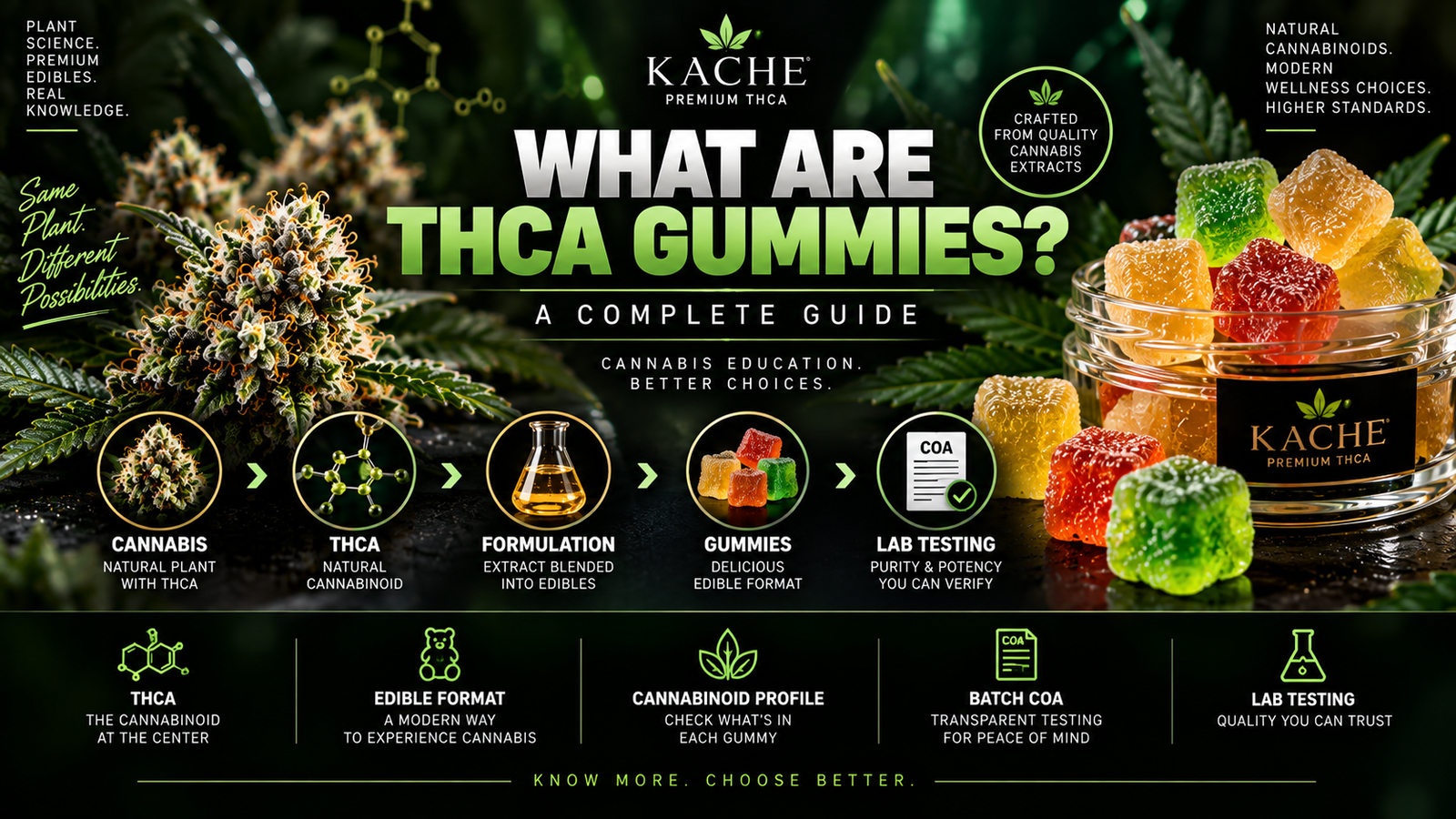
THCA gummies have become one of the most confusing categories in the modern cannabinoid market.
At first glance, the concept sounds simple.
Cannabis flower contains THCA, so manufacturers put THCA into a gummy.
But the chemistry behind these products makes the story considerably more complicated.
THCA, or tetrahydrocannabinolic acid, is the acidic precursor to delta-9 THC. In its unconverted form, THCA is chemically and pharmacologically different from delta-9 THC. When sufficient heat is applied, THCA can undergo decarboxylation and become THC.
That distinction is especially important with edibles.
Consumers sometimes assume that anything labeled “THCA gummies” will behave exactly like cannabis flower after it is heated. That isn’t necessarily true.
Product formulation, processing, cannabinoid composition and the actual laboratory analysis all matter.
In this complete guide, we’ll explain what THCA gummies are, how they differ from conventional THC gummies, why decarboxylation matters, what live rosin gummies mean, how to read a gummy label and what to check on a Certificate of Analysis before evaluating a product.
What Is THCA?
Before understanding THCA gummies, it helps to understand THCA itself.
THCA stands for:
Tetrahydrocannabinolic acid.
It is one of the acidic cannabinoids naturally associated with cannabis.
Fresh cannabis doesn’t simply produce all of its THC directly in the neutral delta-9 form.
Instead, substantial amounts can be present as THCA.
Under appropriate conditions, THCA can lose a carboxyl group as carbon dioxide and convert into delta-9 THC.
This chemical process is called:
Decarboxylation.
In simplified form:
THCA → heat/time → delta-9 THC + CO₂
Recent scientific literature continues to describe decarboxylation as a temperature- and time-dependent process in which acidic cannabinoids such as THCA are converted into their corresponding neutral cannabinoids.
If you want the complete chemistry explanation first, read:
THCA vs THC: What’s the Difference?
What Are THCA Gummies?
THCA gummies are edible products marketed as containing tetrahydrocannabinolic acid or a cannabinoid formulation associated with THCA.
That definition sounds deliberately cautious because the market doesn’t use the term consistently.
One gummy may contain predominantly unconverted THCA.
Another product marketed as a THCA gummy may contain THCA alongside other cannabinoids.
Another may contain cannabinoids that have undergone some degree of conversion during manufacturing.
This means you shouldn’t determine the chemical composition of a gummy from its front label alone.
The better question is:
What does the batch-specific laboratory report actually show?
Look specifically for amounts of:
- THCA
- Delta-9 THC
- CBD
- CBDA
- CBG
- Delta-8 THC, if present
- Other cannabinoids listed on the panel
This becomes especially important when the marketing description and laboratory results don’t tell exactly the same story.
Why THCA Gummies Are Different From THCA Flower
THCA flower and THCA gummies are not simply two shapes of the same product.
Flower is plant material.
Gummies are manufactured edible formulations.
With flower, cannabinoids remain within the natural plant matrix until the product is processed or used.
A gummy, meanwhile, requires multiple manufacturing stages.
These can include:
Cannabinoid extraction → formulation → mixing → gummy production → flavoring → packaging
That means the cannabinoid composition of a gummy depends heavily on the manufacturer’s process.
If you’re starting with the flower side of the subject, read:
What Is THCA Flower? Complete Beginner’s Guide
Understanding flower first makes the edible category much easier to understand.
Do THCA Gummies Contain THC?
They can.
This is why laboratory testing matters.
A product marketed as a THCA gummy may contain measurable amounts of delta-9 THC in addition to THCA.
The exact proportions depend on formulation and processing.
Furthermore, THCA can convert into THC under sufficient heat.
Published research on cannabis-infused foods specifically notes that heat is required to decarboxylate THCA into THC and that conversion may occur before or during food processing.
Therefore, you shouldn’t automatically assume:
“THCA gummy = no THC.”
Nor should you assume:
“THCA gummy = normal delta-9 THC gummy.”
Read the actual composition.
Do THCA Gummies Get You High?
This question needs a more careful answer than you’ll often see in marketing material.
Unconverted THCA itself doesn’t produce the same classic intoxicating effect associated with delta-9 THC.
However, a product called a THCA gummy may contain other cannabinoids, including delta-9 THC, or may have undergone processing that alters its cannabinoid composition.
Therefore, the effect of a particular gummy cannot reliably be predicted from the words “THCA gummy” alone.
The product’s:
ingredient list + cannabinoid panel + batch-specific COA
are much more informative.
Also remember that products containing psychoactive THC can impair judgment and coordination and should be kept away from children and pets. FDA has raised concerns about intoxicating cannabinoid products appearing in candy-like edible forms and about variability between marketed cannabinoid products.
Why Decarboxylation Matters So Much
Decarboxylation is probably the single most important scientific concept behind THCA gummies.
THCA contains a carboxyl group.
When heat is applied, the molecule can release carbon dioxide and become delta-9 THC.
This doesn’t mean every molecule converts instantly.
Conversion depends on factors such as:
Temperature
Time
Processing conditions
Storage
Scientific reviews continue to show that heat is the dominant driver of decarboxylation during processes such as smoking, vaping and baking, while slower conversion can also occur during prolonged storage.
That explains why THCA flower, heated cannabis and edible formulations shouldn’t automatically be treated as chemically identical.
THCA Gummies vs THC Gummies
Here’s the basic distinction.
| Feature | THCA Gummies | Conventional THC Gummies |
|---|---|---|
| Main marketed cannabinoid | THCA | THC |
| May contain THCA | Yes | Sometimes |
| May contain delta-9 THC | Possibly | Yes |
| Manufactured edible | Yes | Yes |
| Composition depends on formulation | Yes | Yes |
| COA important | Yes | Yes |
| Effects predictable from name alone | No | No |
| Decarboxylation relevant | Very | Already relevant to THC production |
The most important difference is the cannabinoid form.
THCA is acidic.
Delta-9 THC is neutral.
But the actual contents of commercial gummies can be considerably more complicated than those two labels suggest.
Are THCA Gummies the Same as Delta-9 Gummies?
No.
They shouldn’t automatically be treated as interchangeable.
Delta-9 gummies are formulated around delta-9 tetrahydrocannabinol.
A true THCA-focused gummy is formulated around tetrahydrocannabinolic acid.
But products can contain mixtures.
What About Delta-8 Gummies?
Delta-8 THC is another cannabinoid entirely.
It shouldn’t be confused with THCA simply because both products may be marketed as hemp-derived.
FDA has specifically warned consumers that delta-8 THC is psychoactive and that products marketed with delta-8 have not been evaluated or approved by the agency for safe use. FDA has also highlighted concerns about manufacturing, labeling variability and candy-like presentation.
This demonstrates why terms such as:
hemp gummy
THCA gummy
delta-8 gummy
and
delta-9 gummy
shouldn’t be used interchangeably.
They can represent very different cannabinoid formulations.
What Are Live Rosin Gummies?
Another term you’ll encounter is:
live rosin gummies.
These typically use a cannabis-derived ingredient associated with live rosin rather than only a highly isolated cannabinoid input.
Live rosin itself is generally made from fresh-frozen cannabis using solventless mechanical processing.
The usual concept is:
Fresh-frozen cannabis → trichome separation → hash → heat + pressure → live rosin
If you want to understand that process first, read:
What Is Live Rosin? A Complete Guide
The important point is that “live rosin gummy” describes something about the cannabis input used in the formulation.
It doesn’t automatically tell you the final amounts of THCA or THC.
Again:
Check the COA.
THCA Gummies vs Live Rosin Gummies
The distinction can become confusing because the two categories may overlap.
A manufacturer may market a gummy around:
THCA
or around:
live rosin
or both.
THCA refers primarily to a specific cannabinoid.
Live rosin refers primarily to a concentrate type and production approach.
Therefore:
THCA = cannabinoid
Live rosin = concentrate/process category
A live rosin product can contain multiple cannabinoids.
A THCA gummy can be manufactured using different cannabinoid inputs.
These terms answer different questions.
What Are Live Resin Gummies?
Live resin differs from live rosin.
Although both commonly use fresh cannabis material, live resin is generally produced through solvent extraction, while live rosin is categorized as solventless.
We’ve already covered this distinction in depth here:
Live Rosin vs Live Resin: What’s the Difference?
For gummies, these terms generally describe the cannabis concentrate used in formulation rather than a universal cannabinoid percentage.
THCA Gummies vs Cannabis Flower
The biggest practical difference is that one is a manufactured edible and the other is plant material.
THCA flower contains the plant’s natural combination of:
- Cannabinoids
- Terpenes
- Flavonoids
- Plant material
- Trichomes
- Moisture
- Other components
A gummy is formulated.
Manufacturers determine what concentrate or cannabinoids go into it.
This makes product transparency especially important.
Why Gummy Labels Matter
A professional edible product should provide enough information for consumers to understand what they’re looking at.
Don’t focus only on large front-label numbers.
Read the details.
Important information may include:
Cannabinoids per gummy
Does the stated amount refer to one gummy or the entire package?
Gummies per package
This matters when interpreting total cannabinoid numbers.
Ingredient list
Cannabinoids are only part of an edible.
Allergen information
Particularly important for anyone with known food allergies.
Batch or lot information
This can help connect the product to its laboratory documentation.
Storage instructions
Follow the manufacturer’s instructions.
Warnings
Cannabis edibles should be kept securely away from children and pets.
Per Gummy vs Per Package
This is one of the easiest mistakes to make when reading cannabinoid edible packaging.
Suppose a package displays:
200 mg
Does that mean:
200 mg per gummy?
or:
200 mg in the entire package?
Those are completely different formulations.
Always determine whether a cannabinoid number refers to:
each serving
or
the complete package.
Never rely solely on the largest number printed on the front.
Why the Certificate of Analysis Matters
A Certificate of Analysis, often shortened to COA, can provide more detailed information about the product.
The cannabinoid panel may report:
- THCA
- Delta-9 THC
- CBD
- CBDA
- CBG
- CBGA
- Other cannabinoids
The report may also include contaminant testing, depending on what was ordered and applicable requirements.
Potential panels include:
Pesticides
Heavy metals
Microbial testing
Mycotoxins
Residual solvents
Do not assume that because a product has a potency COA it has automatically been tested for everything else.
Does a QR Code Mean a Product Has Been Tested?
Not necessarily.
A QR code is just a method of linking information.
What matters is where it goes.
When reviewing a laboratory report, check whether:
- The product name matches
- The batch or lot matches
- The report is readable
- The test date is shown
- The cannabinoid panel is present
- The laboratory is identified
- Relevant contaminant panels are shown
Don’t treat the presence of a QR code as proof by itself.
Why Batch-Specific Testing Is Better
Cannabis products are manufactured in batches.
Two packages with the same brand and flavor may have been produced at different times from different ingredient lots.
A batch-specific COA helps connect testing to the actual production batch.
This is much more informative than a generic laboratory report displayed indefinitely for an entire product line.
Are Higher-Milligram Gummies Better?
Not automatically.
This is one of the most persistent mistakes in cannabinoid shopping.
A bigger number doesn’t prove:
- Better ingredients
- Better manufacturing
- Better testing
- Better flavor
- Better consistency
- Better transparency
Cannabinoid amount is simply one product characteristic.
The same philosophy applies to THCA flower.
Higher THCA percentage alone doesn’t automatically make one flower superior to another.
Quality is multidimensional.
Are THCA Gummies “Full Spectrum”?
This depends entirely on the formulation.
Full spectrum is used broadly in cannabis marketing, but there isn’t one universal formulation behind every product bearing that label.
A gummy made from a multi-component cannabis extract may contain several cannabinoids and other plant-derived compounds.
A gummy made primarily from isolated THCA may have a much narrower chemical profile.
If a manufacturer uses terms such as:
full spectrum
broad spectrum
whole plant
or
live rosin
look at the actual ingredients and laboratory data.
Marketing terminology shouldn’t substitute for chemistry.
Do Terpenes Matter in THCA Gummies?
Terpenes contribute strongly to the aroma of cannabis flower and concentrates.
However, an edible is a very different format.
The significance of terpenes in a particular gummy depends on the formulation and the specific cannabis-derived ingredients used.
A live rosin gummy, for example, may use a concentrate that contains a broader range of plant-derived compounds than a gummy manufactured from a single isolated cannabinoid.
But you still shouldn’t assume a terpene profile without evidence.
What Ingredients Are Usually in Gummies?
Cannabis gummies are still food products.
Beyond their cannabinoid ingredients, formulations may contain components such as:
- Sweeteners
- Glucose syrup
- Pectin or gelatin
- Flavorings
- Acids
- Coloring
- Oils
- Coating ingredients
The exact formulation varies by manufacturer.
Consumers with food allergies or dietary restrictions should therefore read the full ingredient list rather than focusing only on cannabinoid content.
Pectin vs Gelatin Gummies
These are two common structural ingredients used in gummy production.
Gelatin is animal-derived.
Pectin is plant-derived and commonly obtained from fruit sources.
Therefore, consumers looking for plant-based gummies may prefer products formulated with pectin.
But don’t infer vegan status solely from pectin being present.
The entire ingredient list should be checked.
Why Edible Consistency Matters
Manufacturing consistency is particularly important with cannabinoid gummies.
Ideally, cannabinoids should be distributed predictably throughout the formulation.
If a product is poorly manufactured, individual pieces could potentially vary.
This is another reason to favor transparent manufacturers and batch-specific laboratory documentation instead of relying solely on attractive packaging.
FDA has expressed broader concerns about cannabinoid products whose actual composition does not reliably match their labeling, illustrating why manufacturing controls and accurate product information matter.
Are THCA Gummies FDA Approved?
Do not assume so.
The presence of a cannabis-derived ingredient in a product does not mean FDA has evaluated or approved that product.
FDA has repeatedly cautioned that many cannabis-derived consumer products have not undergone FDA drug approval or safety evaluation and has taken enforcement action against companies making unsupported therapeutic claims.
For current information, see:
FDA: What You Need to Know About Cannabis-Derived Products
This is also why Kache blog content should avoid claims that gummies:
treat anxiety
cure pain
improve disease
or provide other unapproved medical benefits.
Are THCA Gummies Legal?
This isn’t a question that should be answered with one blanket sentence.
Cannabis and hemp rules can vary significantly according to:
- Federal law
- State law
- Product composition
- Total cannabinoid content
- Product category
- Manufacturing rules
- Sales restrictions
Rules are also changing.
Therefore, avoid assuming that a product marketed online as “THCA” is automatically lawful everywhere.
Consumers and businesses should verify the rules applicable to their location and product.
This is particularly important for edible cannabinoid products because food regulation can involve legal considerations beyond the cannabis plant itself.
THCA Gummies and Children
Cannabinoid gummies can resemble ordinary candy.
That creates a serious storage issue.
Cannabis-containing edible products should be kept securely away from children and pets.
FDA has specifically highlighted risks associated with intoxicating cannabinoid products marketed in forms such as gummies, candies and other foods that may appeal to children.
Packaging should never be treated as childproof simply because it has cannabis warnings printed on it.
THCA Gummies During Pregnancy or Breastfeeding
FDA advises against the use of THC, marijuana and CBD during pregnancy and while breastfeeding.
Consumers who are pregnant, breastfeeding, taking medication or managing medical conditions should discuss cannabis-derived products with an appropriate healthcare professional.
This is a much more responsible approach than relying on social-media claims about cannabinoid products.
How to Evaluate THCA Gummies
When comparing gummies, focus on the evidence behind the product.
1. Check the actual cannabinoids
Does the COA show THCA, delta-9 THC or a mixture?
2. Determine the serving amount
Know whether the stated milligrams are per gummy or per package.
3. Read the ingredients
Pay attention to sweeteners, allergens and whether the product meets your dietary requirements.
4. Verify the batch
Look for batch-specific laboratory documentation.
5. Examine testing
Find out which contaminant panels were actually performed.
6. Ignore vague superlatives
Words such as premium, pure and strongest aren’t laboratory measurements.
7. Check storage instructions
Follow the manufacturer’s recommendations.
Kache Premium Live Rosin Gummies
Our edibles range includes different cannabis-derived product formats, including Live Rosin Gummies and Live Resin Gummies.
Understanding the distinction between these names matters because they tell you something about the concentrate associated with the formulation.
Live rosin is associated with solventless processing.
Live resin is generally associated with solvent extraction from fresh cannabis material.
You can explore our current edible selection here:
Explore Kache Premium THCA Edibles
When evaluating an individual product, check its current product information and laboratory documentation rather than assuming every product within a category has an identical cannabinoid profile.
THCA Gummies vs Other Kache Product Formats
Different product formats answer different consumer preferences.
| Product | Format | Primary Characteristic |
|---|---|---|
| THCA Flower | Flower | Cannabis plant material |
| THCA Diamonds | Concentrate | Crystalline THCA |
| Live Rosin | Concentrate | Solventless concentrate |
| Live Resin | Concentrate | Solvent-extracted fresh-material concentrate |
| THCA Gummies | Edible | Formulated cannabinoid edible |
| Live Rosin Gummies | Edible | Gummy formulated with live-rosin-derived input |
If concentrates interest you more than edibles, continue with:
THCA Diamonds: What Are They? Complete Guide
Common THCA Gummies Myths
Myth: THCA gummies and THC gummies are exactly the same.
No. THCA and delta-9 THC are different cannabinoid forms, although product formulations may contain both.
Myth: Every gummy labeled THCA contains only THCA.
Not necessarily. Read the ingredients and cannabinoid COA.
Myth: THCA automatically means non-intoxicating product.
That conclusion can be misleading for a manufactured product that may contain additional cannabinoids or converted THC.
Myth: A higher milligram number means better quality.
No. Cannabinoid quantity doesn’t prove manufacturing or ingredient quality.
Myth: Hemp gummies can’t be intoxicating.
The term “hemp” alone doesn’t establish a product’s pharmacological effect. FDA has specifically warned that some hemp-derived cannabinoid products, such as delta-8 THC products, are psychoactive.
Myth: A QR code proves a gummy is safe.
No. You must examine the report the code links to.
Myth: Natural means risk-free.
No. A compound’s natural origin doesn’t establish safety.
Myth: All cannabis gummies are FDA approved.
No. Consumers should not interpret ordinary cannabis-product marketing as FDA approval.
Frequently Asked Questions About THCA Gummies
What are THCA gummies?
THCA gummies are edible cannabinoid products marketed as containing tetrahydrocannabinolic acid or a THCA-related formulation.
Is THCA the same as THC?
No. THCA is the acidic precursor to delta-9 THC. Heat can convert THCA into THC through decarboxylation.
Do THCA gummies contain delta-9 THC?
Some may. The individual product’s laboratory report should be checked.
Are THCA gummies intoxicating?
The product name alone isn’t enough to determine that. Unconverted THCA differs from delta-9 THC, but commercial formulations can contain other cannabinoids. Check the COA.
Are THCA gummies the same as delta-9 gummies?
No. Delta-9 gummies are formulated around delta-9 THC, while THCA products are marketed around THCA. Some formulations may nevertheless contain multiple cannabinoids.
What are live rosin gummies?
Live rosin gummies are edible products formulated using an ingredient derived from live rosin, a solventless concentrate generally produced from fresh-frozen cannabis material.
Are live rosin gummies the same as THCA gummies?
Not necessarily. “THCA” refers to a cannabinoid, while “live rosin” refers to a concentrate and production category.
What should I check before evaluating a THCA gummy?
Review the cannabinoid content, serving size, ingredients, batch number and relevant laboratory testing.
Does a COA matter?
Yes. It gives you considerably more information than marketing language alone.
Are THCA gummies legal everywhere?
No blanket statement should be assumed. Laws and regulations vary by jurisdiction and product formulation.
Final Thoughts: What Are THCA Gummies?
THCA gummies sit at an interesting intersection between cannabis chemistry and food manufacturing.
THCA itself is relatively straightforward:
It is an acidic cannabinoid associated with cannabis and a chemical precursor to delta-9 THC.
But putting the words “THCA gummies” on a package doesn’t tell you everything about the product inside.
You still need to know:
How much THCA is present?
Is delta-9 THC present?
Are other cannabinoids included?
Is the amount listed per gummy or per package?
Which laboratory tests were completed?
Does the batch number match the COA?
That is why informed shopping begins with transparency rather than marketing terminology.
At Kache Premium, our educational goal is to help customers understand the differences between cannabis product categories before comparing individual products.
If you’re new to THCA, begin with:
What Is THCA Flower? Complete Beginner’s Guide
Then understand the cannabinoid chemistry with:
THCA vs THC: What’s the Difference?
If you’re interested in how cannabis concentrates make their way into products, continue with:
What Is Live Rosin? A Complete Guide
Or explore the current:

One thought on “What Are THCA Gummies? Complete Guide to THCA Edibles”
Pingback: THCA Gummies vs Delta-9 Gummies: Key Differences - Kache Premium Thca