
THCA vs THC: What’s the Difference?
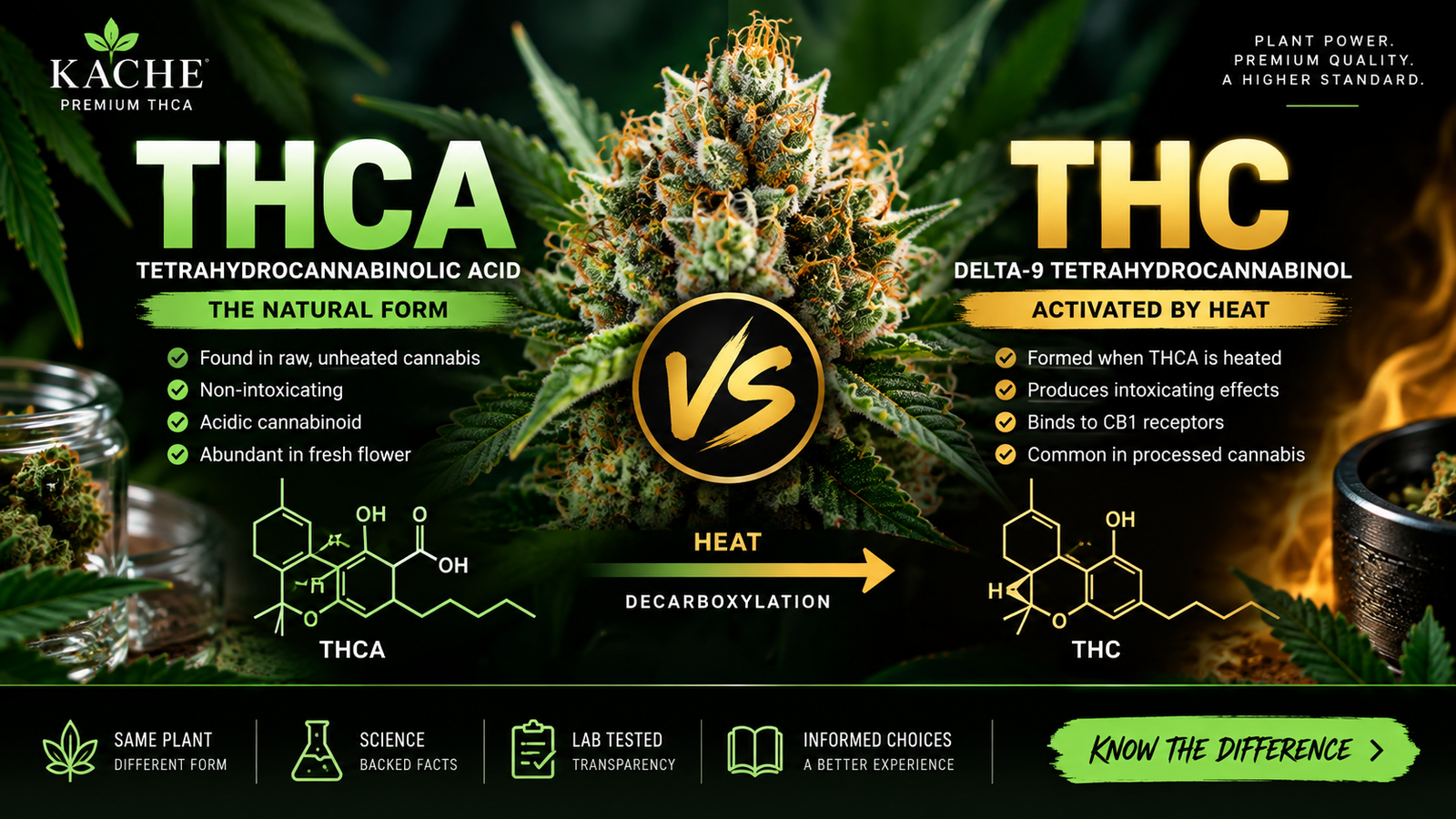
THCA vs THC is one of the most misunderstood topics in cannabis.
The two compounds are closely related, come from the same plant, and often appear together on laboratory reports. Yet they are not chemically identical and they do not behave in exactly the same way.
That distinction matters.
THCA stands for tetrahydrocannabinolic acid, while THC usually refers to delta-9 tetrahydrocannabinol.
THCA is naturally present in fresh and minimally processed cannabis. Delta-9 THC can form when THCA undergoes a chemical reaction known as decarboxylation.
This reaction can occur when sufficient heat is applied and can also happen more slowly over time.
In simple terms:
THCA is a precursor to THC.
Understanding that relationship makes everything else about THCA flower, cannabis potency, laboratory testing, and product labeling easier to understand.
In this guide, we break down THCA vs THC, explain how they are connected, show why heat matters, discuss laboratory results, and explain what consumers should actually look for when comparing products.
What Is THCA?
THCA means tetrahydrocannabinolic acid.
It is one of the naturally occurring acidic cannabinoids produced by Cannabis sativa.
Cannabis plants do not simply begin life filled with large amounts of delta-9 THC.
Instead, cannabinoids are produced through a series of biochemical processes inside the plant.
As cannabis flowers mature, resin-producing structures called glandular trichomes become increasingly important.
These microscopic structures are found across the flowers and surrounding leaves and contain many of the compounds associated with cannabis, including cannabinoids and aromatic compounds.
THCA can accumulate in these trichomes as the plant matures.
This is why freshly harvested cannabis often contains substantial THCA even when its immediately measured delta-9 THC concentration is comparatively lower.
What Is THC?
THC generally refers to delta-9 tetrahydrocannabinol.
Delta-9 THC is one of the best-known cannabinoids in cannabis.
It is particularly notable because it is associated with the intoxicating effects commonly described as a cannabis “high.”
THC interacts with the body’s endocannabinoid system, including cannabinoid receptors such as CB1 receptors.
Because of that interaction, delta-9 THC can affect perception, cognition, coordination, mood, and other functions.
The key distinction is that THCA itself does not interact with the body in exactly the same manner as delta-9 THC.
This difference is largely related to their molecular structures.
THCA vs THC at a Glance
Here is the simplest way to understand the difference.
| Characteristic | THCA | Delta-9 THC |
|---|---|---|
| Full name | Tetrahydrocannabinolic acid | Delta-9 tetrahydrocannabinol |
| Naturally present in raw cannabis | Yes | Usually present in lower amounts depending on material and processing |
| Acidic cannabinoid | Yes | No |
| Intoxicating like THC | Generally no | Yes |
| Can convert through heat | Converts into THC | Already decarboxylated |
| Found on lab reports | Yes | Yes |
| Important for total THC calculations | Yes | Yes |
The compounds are closely related, but they should not be treated as interchangeable.
Why THCA and THC Have Different Effects
The difference comes down to molecular structure.
THCA contains an additional carboxyl group that is not present in delta-9 THC.
That structural difference affects how the molecule interacts with receptors in the body.
Delta-9 THC interacts strongly with CB1 cannabinoid receptors in the central nervous system.
This interaction contributes to its intoxicating effects.
THCA does not bind to those receptors in the same way.
This is why unheated THCA is generally considered non-intoxicating in the same manner as delta-9 THC.
However, that can change once decarboxylation occurs.
What Is Decarboxylation?
Decarboxylation is one of the most important concepts in understanding THCA vs THC.
During decarboxylation, THCA loses a carboxyl group.
That chemical change converts THCA into delta-9 THC.
The process can be accelerated by heat.
In simplified form:
THCA → heat → delta-9 THC
This is why heating cannabis can significantly change its cannabinoid composition.
Scientific and regulatory testing methods take this potential conversion into account.
USDA hemp testing guidance, for example, requires compliance testing methods that consider the potential conversion of THCA into THC when determining total THC.
Does THCA Naturally Turn Into THC?
Yes.
THCA can gradually decarboxylate over time.
However, heat significantly accelerates the process.
Factors that can influence cannabinoid changes include:
- Temperature
- Time
- Storage conditions
- Light exposure
- Processing
- Moisture
This is one reason the cannabinoid profile of freshly harvested plant material may not be identical to the profile of older or heavily processed material.
Is THCA Intoxicating?
THCA itself is generally regarded as non-intoxicating in the way delta-9 THC is.
That distinction is important.
However, products containing large amounts of THCA can potentially produce intoxicating THC after sufficient heating or other decarboxylation.
So when evaluating a product, consumers should not simply assume that a high THCA percentage means the same thing as consuming unconverted THCA.
The method of use and the chemical state of the cannabinoids matter.
Does THC Get You High?
Delta-9 THC is the primary cannabinoid associated with the intoxicating effects traditionally linked to cannabis.
The U.S. Food and Drug Administration identifies THC as the compound responsible for the “high” commonly associated with marijuana.
The intensity of effects can vary according to numerous factors, including:
- Amount consumed
- Product formulation
- Individual tolerance
- Route of administration
- Other cannabinoids present
- Individual physiology
Because response can vary considerably between individuals, product labels and laboratory information should be taken seriously.
Why THCA Flower Can Contain Both THCA and THC
Cannabis flower often contains multiple cannabinoids simultaneously.
A laboratory analysis may therefore show results for:
- THCA
- Delta-9 THC
- CBDA
- CBD
- CBGA
- CBG
- Other minor cannabinoids
THCA-rich flower can still contain measurable delta-9 THC.
That does not automatically mean the laboratory report is wrong.
Cannabinoids exist within a changing chemical system, and some conversion may occur during plant maturation, drying, curing, storage, testing, or processing.
What Does “Total THC” Mean?
This is where many consumers become confused.
A laboratory report may display:
- THCA percentage
- Delta-9 THC percentage
- Total THC
These are not necessarily three measurements of the same thing.
Total THC is commonly calculated to estimate the amount of THC that could be present after accounting for conversion of THCA into THC.
Because the THCA molecule loses mass during decarboxylation, laboratories commonly use a conversion factor.
A frequently used calculation is approximately:
Total THC = delta-9 THC + (THCA × 0.877)
The 0.877 factor reflects the molecular-weight difference between THCA and THC after decarboxylation.
This distinction is important when reading cannabis laboratory reports.
Why USDA Hemp Testing Considers THCA
For U.S. hemp production compliance, USDA does not simply ignore THCA.
USDA laboratory guidelines state that total THC testing must account for the potential conversion of THCA into delta-9 THC.
That means hemp compliance testing is designed around total available THC, not just an isolated delta-9 THC number.
This is an important regulatory distinction because online discussions sometimes oversimplify hemp rules by looking only at one cannabinoid measurement.
THCA vs THC: Which One Is Naturally More Common in Fresh Flower?
In fresh, mature cannabis flower, THCA can be present in substantial quantities because the plant naturally produces acidic cannabinoid precursors.
Delta-9 THC can also be present, but significant conversion from THCA can occur later through drying, aging, processing, or heating.
This is why laboratory reports for flower frequently show THCA as one of the dominant cannabinoid measurements.
THCA vs THC Flower: Is There Really a Difference?
The terminology can be confusing.
From a botanical standpoint, both products originate from Cannabis sativa.
The major differences generally relate to:
- Cannabinoid composition
- Legal classification
- Testing results
- Cultivation and compliance requirements
- Product labeling
A flower marketed as THCA flower may visually resemble other cannabis flower because the plant material itself is still cannabis.
The laboratory profile and regulatory context are what matter most.
For a deeper explanation, read our:
What Is THCA Flower? Complete Beginner’s Guide
THCA vs THC: Appearance
You cannot reliably determine the cannabinoid composition of cannabis simply by looking at it.
THCA-rich flower and THC-dominant cannabis may both display:
- Dense flower structures
- Orange or amber pistils
- Green and purple coloration
- Heavy trichome coverage
- Similar aromas
- Similar cultivar names
Visual appearance tells you something about the plant’s physical characteristics.
It does not replace laboratory analysis.
THCA vs THC: Aroma and Terpenes
THCA and THC themselves are not responsible for the full range of cannabis aromas.
Many of those aromas come from compounds including terpenes.
Common cannabis terpenes include:
Myrcene
Often associated with earthy or herbal aromas.
Limonene
Frequently associated with citrus-like aromas.
Pinene
Often associated with pine-like characteristics.
Caryophyllene
Can contribute spicy or pepper-like notes.
Linalool
Frequently associated with floral aromas.
Two flower samples with very different THC or THCA percentages can still have similar terpene profiles.
Likewise, two products with similar cannabinoid percentages may smell completely different.
Why Cannabinoid Percentage Isn’t the Whole Story
Consumers frequently compare cannabis products using one number:
THCA percentage.
That number is useful, but it does not tell you everything about quality.
Flower quality can also depend on:
- Genetics
- Trichome development
- Terpene preservation
- Harvest timing
- Drying
- Curing
- Storage
- Freshness
- Contaminant testing
- Handling
At Kache Premium, we encourage customers to look beyond the biggest percentage on the label.
A high cannabinoid number does not automatically guarantee better flower.
How We Evaluate THCA Flower
Our approach starts with the plant itself.
We consider:
Genetics
Strong genetics establish the foundation for cannabinoid production, plant structure, terpene expression, and overall quality.
Cultivation
Environmental control influences plant health and flower development.
Trichome Development
Healthy resin production is an important characteristic of mature cannabis flowers.
Harvest Timing
Harvesting too early or too late can influence final product characteristics.
Drying and Curing
Post-harvest handling can significantly influence aroma, moisture, texture, and overall quality.
Laboratory Information
Testing helps verify cannabinoid composition and can provide additional information when contaminant panels are included.
To see how our cultivation philosophy works from seed through harvest, read our:
How Cannabis Is Grown: Our Complete Seed-to-Harvest Process
THCA vs THC in a Certificate of Analysis
A Certificate of Analysis, commonly called a COA, is one of the most useful tools consumers can use when comparing cannabis products.
A cannabinoid section may list:
THCA: percentage detected
Delta-9 THC: percentage detected
CBD: percentage detected
CBDA: percentage detected
CBG: percentage detected
Depending on the laboratory, the report may also calculate:
Total THC
and sometimes:
Total CBD
The important point is that a COA allows you to examine actual laboratory measurements instead of relying entirely on packaging claims.
What Else Should a COA Show?
A complete testing program may include much more than cannabinoids.
Depending on the product, laboratory analysis can include:
- Pesticides
- Heavy metals
- Microbial contamination
- Mycotoxins
- Residual solvents
- Foreign material
- Moisture
- Water activity
Not every COA includes all of these panels.
Consumers should check exactly what was tested rather than assuming that the words “lab tested” automatically mean every possible safety test was performed.
THCA vs THC: Legal Considerations
Cannabis laws are complicated and continue to change.
Federal hemp production rules, state laws, tribal rules, product regulations, and controlled-substance laws can differ.
USDA regulates hemp production and requires compliant hemp crops to meet its total THC testing framework.
However, USDA also notes that states and tribal governments may impose additional requirements, and downstream consumer products can fall under other regulatory authorities.
For that reason, we avoid claiming that a particular cannabinoid product is automatically legal everywhere.
Customers should verify the laws applicable to their location.
THCA vs THC: Which Is Better?
There is no scientifically meaningful universal answer.
“Better” depends entirely on what someone is comparing.
If the question is chemistry, THCA and THC represent different chemical forms.
If the question is product quality, cannabinoid percentage alone is not enough.
If the question is legal classification, location-specific laws matter.
If the question is flower quality, cultivation, genetics, terpene preservation, laboratory documentation, curing, and storage may all matter.
A better question is:
What exactly am I trying to evaluate?
That leads to a much more useful comparison.
Common Misconceptions About THCA vs THC
Myth 1: THCA and THC are exactly the same thing
They are chemically related but not identical.
Myth 2: THCA has nothing to do with THC
Incorrect.
THCA is a precursor that can convert into delta-9 THC through decarboxylation.
Myth 3: THCA percentage tells you everything about quality
It doesn’t.
Potency is only one part of flower quality.
Myth 4: You can identify THCA flower by looking at it
You cannot reliably determine cannabinoid composition visually.
Laboratory testing is necessary.
Myth 5: A low delta-9 THC number means THCA never matters
Not necessarily.
Regulatory testing can account for THCA because of its potential conversion into THC.
Myth 6: All products labeled “lab tested” received the same tests
No.
The analytical panels included can vary considerably.
Always examine the actual COA.
What Should You Look for Before Buying THCA Products?
Before purchasing a THCA product, we recommend checking several things.
Product-specific laboratory information
Look for a COA that can reasonably be connected to the product or batch.
Cannabinoid profile
Don’t focus only on one percentage.
Review the entire cannabinoid panel.
Cultivation information
Understanding how flower was grown can provide useful context.
Product photography
Clear photographs allow customers to evaluate visible flower structure and condition.
Brand transparency
A professional supplier should clearly explain its products, policies, testing approach, and relevant restrictions.
Applicable local law
Always check the rules that apply where the product will be purchased, shipped, possessed, or used.
THCA vs THC FAQ
What is the main difference between THCA and THC?
THCA is tetrahydrocannabinolic acid, while THC usually refers to delta-9 tetrahydrocannabinol. THCA is an acidic precursor that can convert into THC through decarboxylation.
Does THCA turn into THC?
Yes. THCA can convert into delta-9 THC, particularly when sufficient heat is applied.
Does THCA get you high?
THCA itself is generally considered non-intoxicating in the same way as delta-9 THC. However, THCA can convert into intoxicating THC through decarboxylation.
Does THC get you high?
Delta-9 THC is the cannabinoid most strongly associated with the intoxicating “high” traditionally associated with cannabis.
Can THCA flower contain THC?
Yes. A flower sample can contain both THCA and measurable delta-9 THC.
Why do laboratories calculate total THC?
Total THC calculations account for both existing delta-9 THC and the amount that could potentially result from THCA conversion.
Can you tell THCA flower from THC flower visually?
No. Appearance alone cannot reliably establish a product’s cannabinoid composition.
Is THCA legal?
The answer depends on jurisdiction, product type, testing results, and applicable laws. Cannabis and hemp regulations vary, so consumers should verify current rules for their location.
Final Thoughts: THCA vs THC
The THCA vs THC distinction becomes straightforward once you understand one central concept:
THCA is an acidic cannabinoid that can convert into delta-9 THC through decarboxylation.
That single chemical relationship explains why THCA and THC can appear separately on laboratory reports, why heating matters, and why regulators may consider both compounds when evaluating cannabis material.
But the larger lesson is equally important.
Cannabis quality cannot be reduced to a single cannabinoid percentage.
At Kache Premium, we look at the complete picture: genetics, cultivation, trichome development, terpene preservation, harvest timing, drying, curing, testing, handling, and storage.
If you are just beginning your research, continue with our What Is THCA Flower? Complete Beginner’s Guide.
If you want to see where flower quality begins, explore our How Cannabis Is Grown guide.
And when comparing products, always read the laboratory documentation instead of relying only on the number printed most prominently on the package.

5 thoughts on “THCA vs THC: What’s the Difference?”
Pingback: Elementor #5720 - Kache Premium Thca
Pingback: THCA Diamonds: What Are They? Complete Guide
Pingback: What Are THCA Gummies? Complete Guide to THCA Edibles
Pingback: THCA Gummies vs Delta-9 Gummies: Key Differences
Pingback: How to Read a Cannabis Certificate of Analysis (COA): Complete Guide - Kache Premium Thca