
THCA Flower vs Regular Weed: What’s the Difference?
THCA Flower vs Regular Weed: What’s the Difference?
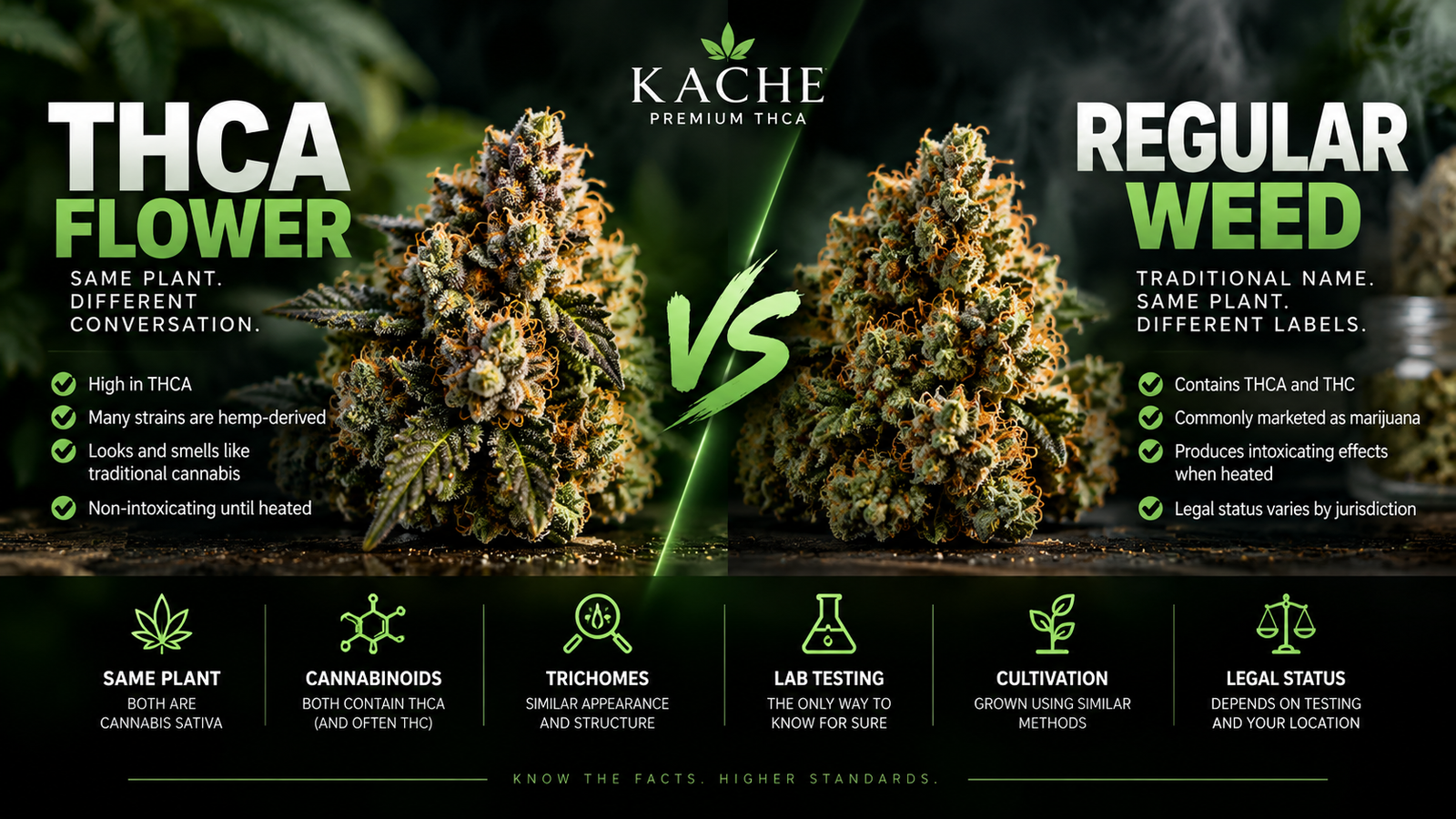
At first glance, THCA flower vs weed can seem like a strange comparison.
Put high-quality THCA flower next to conventional cannabis flower and many people would struggle to tell them apart.
Both can have dense green buds. Both can be covered in sparkling trichomes. Both can carry strong aromas. Both come from Cannabis sativa. And depending on genetics and cultivation, they can look remarkably similar.
So what actually makes THCA flower different from what people commonly call “regular weed”?
The answer isn’t simply appearance.
The distinction involves cannabinoid chemistry, laboratory testing, legal definitions, product classification and, importantly, what happens to THCA when it is heated.
At Kache Premium, we believe customers should understand the plant and the science behind the products they’re considering rather than relying on confusing terminology.
This guide breaks down THCA flower vs regular weed from the plant itself to cannabinoids, cultivation, trichomes, laboratory reports, legal considerations and product quality.
First, What Do We Mean by “Regular Weed”?
“Weed” isn’t a scientific classification.
It’s an informal term commonly used to describe cannabis, particularly cannabis cultivated or sold for its THC content.
Other common terms include:
- Marijuana
- Cannabis
- Bud
- Flower
- Pot
Botanically, these products come from Cannabis sativa.
That immediately reveals something important:
THCA flower and what consumers call regular weed aren’t necessarily two completely different kinds of plants.
Much of the difference comes down to chemistry, testing and legal classification.
What Is THCA Flower?
THCA flower is cannabis flower containing significant concentrations of tetrahydrocannabinolic acid, or THCA.
THCA is naturally produced by the cannabis plant.
It is not simply another marketing name for delta-9 THC.
THCA is an acidic cannabinoid precursor to delta-9 tetrahydrocannabinol.
Fresh cannabis can contain substantial amounts of THCA because cannabinoids in the living plant occur largely in acidic precursor forms.
When THCA undergoes decarboxylation, it can convert into delta-9 THC.
Heat accelerates that process.
In simplified terms:
THCA → heat → delta-9 THC
This relationship is central to understanding why THCA flower can resemble conventional cannabis so closely while still being discussed differently in product and regulatory contexts.
For a complete introduction, read our What Is THCA Flower? Complete Beginner’s Guide.
THCA Flower vs Weed at a Glance
| Feature | THCA Flower | Conventional THC-Rich Cannabis |
|---|---|---|
| Plant | Cannabis sativa | Cannabis sativa |
| THCA naturally present | Yes | Yes |
| Delta-9 THC may be present | Yes | Yes |
| Trichomes | Yes | Yes |
| Terpenes | Yes | Yes |
| Can look visually similar | Yes | Yes |
| THCA can convert to THC | Yes | Yes |
| Intoxicating potential after decarboxylation | Yes | Yes |
| Legal treatment | Depends on jurisdiction and testing | Depends on jurisdiction |
| Laboratory testing important | Yes | Yes |
The table reveals why this topic is often misunderstood.
The two aren’t necessarily distinguishable by sight.
Is THCA Flower Actually Cannabis?
Yes.
THCA flower comes from cannabis.
Cannabis is the plant genus. Terms such as hemp and marijuana are often used as legal or commercial classifications rather than descriptions of entirely unrelated plants.
This is why discussions claiming that THCA flower “isn’t cannabis” can be misleading.
It is cannabis plant material.
The important questions concern its cannabinoid composition, how it was produced and tested, and how applicable laws classify it.
Is THCA Naturally Found in Regular Weed?
Yes.
This is perhaps the most important fact in the entire comparison.
THCA isn’t unique to products marketed as “THCA flower.”
Conventional cannabis flower can also contain substantial THCA before heating.
The cannabis plant biosynthesizes cannabinoids through precursor pathways, and THCA can accumulate within resin-producing glandular trichomes.
Consequently, a laboratory analysis of unheated cannabis flower may show substantial THCA.
When that material is heated, some of the THCA can convert into delta-9 THC.
THCA Flower vs Weed: The Chemistry
The chemical relationship explains much of the confusion.
THCA stands for:
Tetrahydrocannabinolic acid
THC generally refers to:
Delta-9 tetrahydrocannabinol
THCA contains an additional carboxyl group.
When decarboxylation occurs, THCA loses that group and forms THC.
That seemingly small molecular change matters because delta-9 THC interacts differently with cannabinoid receptors in the body.
We explain the chemistry much more deeply in our guide:
THCA vs THC: What’s the Difference?
THCA Flower vs Regular Weed: Can You Tell by Looking?
Usually, no.
Appearance alone isn’t a reliable cannabinoid test.
Premium THCA flower can display many of the same visual characteristics people associate with high-quality conventional cannabis:
- Dense buds
- Bright pistils
- Purple coloration
- Green coloration
- Frosty trichomes
- Resinous surfaces
- Strong aroma
Genetics and growing conditions can dramatically influence appearance.
A photograph therefore cannot tell you precisely how much THCA or delta-9 THC a sample contains.
For that, you need laboratory analysis.
Why Both Can Be Covered in Trichomes
One reason THCA flower and conventional cannabis can look so similar is trichomes.
Trichomes are tiny structures found across cannabis flowers and surrounding plant tissue.
Many glandular trichomes produce and store resin containing cannabinoids and aromatic compounds.
Under magnification, mature trichomes often resemble tiny stalks topped with rounded resin heads.
Heavy trichome coverage can give cannabis its familiar frosted appearance.
But remember:
More visible frost doesn’t automatically tell you the exact cannabinoid percentage.
Laboratory testing remains necessary.
THCA Flower vs Weed: What About the Smell?
They can smell extremely similar.
Cannabis aroma is influenced heavily by volatile compounds, including terpenes.
Common cannabis terpenes include:
Myrcene
Often associated with earthy, herbal or musky aromas.
Limonene
Frequently associated with citrus-like aromas.
Pinene
Often contributes pine-like characteristics.
Caryophyllene
Can produce peppery or spicy notes.
Linalool
Often associated with floral aromas.
These compounds aren’t exclusive to THCA flower or conventional marijuana.
The terpene profile depends largely on genetics, cultivation, maturity and post-harvest handling.
Does THCA Flower Taste Different From Regular Weed?
Not necessarily.
Flavor can be influenced by:
- Genetics
- Terpene profile
- Cultivation
- Harvest maturity
- Drying
- Curing
- Storage
- Product age
Two products with similar cannabinoid percentages can have completely different aromatic and flavor profiles.
Likewise, a THCA flower cultivar and a conventional cannabis cultivar sharing similar genetics may exhibit very similar sensory characteristics.
This is why we don’t evaluate flower quality using cannabinoid percentage alone.
THCA Flower vs Weed: How Are They Grown?
The actual cultivation methods can be extremely similar.
Cannabis can be cultivated using:
- Indoor facilities
- Outdoor fields
- Greenhouses
- Light-assisted environments
During professional cultivation, growers may manage:
- Genetics
- Lighting
- Temperature
- Humidity
- Airflow
- Irrigation
- Plant nutrition
- Root-zone conditions
- Canopy development
- Plant health
The plant doesn’t suddenly require a completely different biological process simply because its finished product will be marketed under a different classification.
At Kache Premium, we consider cultivation fundamental to finished flower quality.
If you want to see the complete process, read:
How Cannabis Is Grown: Our Complete Seed-to-Harvest Process
Why Genetics Matter
Everything starts with genetics.
Genetics influence characteristics including:
- Plant structure
- Flower morphology
- Trichome production
- Cannabinoid expression
- Terpene expression
- Growth characteristics
- Flowering behavior
However, genetics establish potential rather than guaranteeing the final result.
Cultivation conditions and post-harvest handling still matter tremendously.
This is why premium flower begins long before a finished bud reaches its packaging.
Indoor THCA Flower vs Indoor Cannabis
If both products are grown indoors, their cultivation environments can look virtually identical.
Professional indoor facilities may use controlled:
- LED lighting
- Irrigation
- Ventilation
- Temperature
- Humidity
- Air circulation
Indoor cultivation gives growers greater control over environmental variables than open-field cultivation.
That can improve consistency, but indoor cultivation alone doesn’t guarantee premium quality.
Our next guide in this series will explore this subject in detail:
Indoor vs Outdoor THCA Flower: What’s the Difference?
THCA Flower vs Weed: What Happens After Harvest?
Harvest isn’t the end of the process.
Cannabis flower normally undergoes post-harvest handling that can include:
- Harvesting
- Drying
- Trimming
- Curing
- Sorting
- Testing
- Packaging
- Storage
Drying and curing are especially important.
Poor post-harvest handling can negatively affect aroma, moisture, texture and overall flower quality regardless of how well the plant was grown.
This is another reason we believe premium cannabis should be judged on the complete production process rather than a single potency number.
THCA Flower vs Weed: What Happens When Heat Is Applied?
This is where THCA chemistry becomes especially important.
When THCA is exposed to sufficient heat, decarboxylation can convert it into delta-9 THC.
That means the cannabinoid profile of unheated flower isn’t necessarily identical to the chemical profile after substantial heating.
This phenomenon isn’t marketing terminology.
It is established cannabinoid chemistry.
It also explains why regulatory testing can account for the potential conversion of THCA into THC.
Does THCA Flower Get You High?
This question requires precise wording.
THCA itself is generally described as non-intoxicating in the manner associated with delta-9 THC.
However, THCA can convert into delta-9 THC through decarboxylation.
Delta-9 THC is intoxicating.
Therefore, it would be misleading to tell consumers that THCA-rich flower can never result in intoxication simply because the starting material contains substantial THCA.
How the product is processed or used matters.
Does Regular Weed Contain THCA Before It Is Heated?
Yes.
This surprises many consumers.
Cannabis flower commonly contains acidic cannabinoids before heating, including THCA.
So the simplified idea that:
“THCA flower contains THCA while regular weed contains only THC”
is inaccurate.
Both can contain THCA.
The meaningful distinctions involve measured cannabinoid concentrations, processing, testing and legal classification.
THCA Flower vs Weed: What Does the Lab Report Tell You?
A Certificate of Analysis, or COA, can provide much more useful information than appearance.
A cannabinoid panel may report:
- THCA
- Delta-9 THC
- CBDA
- CBD
- CBGA
- CBG
- Other cannabinoids
Some reports also calculate Total THC.
A commonly used calculation is approximately:
Total THC = Delta-9 THC + (THCA × 0.877)
The conversion factor accounts for the molecular-weight change that occurs during decarboxylation.
This is why consumers shouldn’t compare products using only the delta-9 THC line while ignoring THCA.
Why “Total THC” Matters
Total THC is particularly important in regulatory discussions.
USDA hemp-testing guidance accounts for the potential conversion of THCA into THC when determining total THC for hemp production compliance.
This is important because internet discussions sometimes reduce U.S. hemp law to:
“Less than 0.3% delta-9 THC means hemp.”
That explanation can omit important details concerning testing methodology and total THC in the production context.
Regulations also continue to evolve, and downstream consumer-product rules may differ from cultivation rules.
For that reason, we avoid making sweeping statements that every THCA product is automatically legal everywhere.
THCA Flower vs Marijuana: What Does the Law Say?
This is where terminology becomes complicated.
Under U.S. federal law, “hemp” has historically been defined by statute using delta-9 THC concentration on a dry-weight basis, while USDA hemp production testing requires methods that account for THCA’s potential conversion to THC.
However, federal rules are not the entire legal picture.
Individual states can impose additional restrictions, including rules involving:
- THCA
- Total THC
- Consumable hemp
- Age requirements
- Shipping
- Manufacturing
- Retail sales
Rules can change.
Therefore, consumers should check current laws in their own jurisdiction instead of relying on a general statement from a product page or social-media post.
Is THCA Flower Federally Legal?
Be careful with websites that answer this with a universal one-word “yes.”
The regulatory situation is more complicated.
Federal hemp law, USDA production rules, FDA authority, DEA-controlled-substance rules and individual state laws can interact differently depending on the product and circumstances.
The legal landscape surrounding intoxicating or potentially intoxicating hemp-derived products has also continued evolving.
Our approach is therefore straightforward:
We don’t tell customers that a product is automatically lawful everywhere.
Customers should verify current requirements applicable to their location.
THCA Flower vs Weed: Is One Stronger?
Not inherently.
The term “THCA flower” doesn’t establish a universal potency.
Neither does “weed.”
Different cannabis cultivars and batches can contain very different cannabinoid concentrations.
Laboratory testing is the appropriate way to compare cannabinoid profiles.
Even then, a larger percentage shouldn’t automatically be interpreted as better quality.
Why Higher THCA Doesn’t Automatically Mean Better Flower
This deserves emphasis.
Online cannabis marketing often turns potency into a competition.
But flower quality involves much more than one laboratory number.
At Kache Premium, we consider characteristics including:
Genetics
The foundation of plant characteristics.
Cultivation
The conditions under which the plant develops.
Trichome development
An important part of resin production.
Terpene preservation
Critical to aroma and sensory character.
Harvest timing
Important to flower maturity.
Drying
Essential for controlled moisture reduction.
Curing
Important for finished flower character.
Storage
Critical for maintaining quality after processing.
Laboratory information
Necessary for understanding cannabinoid composition and other tested characteristics.
A flower with the largest THCA number isn’t automatically the best flower.
THCA Flower vs Weed: Is One Safer?
The product name alone cannot answer that question.
Safety considerations can depend on:
- Product composition
- Contaminants
- Manufacturing or cultivation conditions
- Testing
- Storage
- Individual use
- Applicable warnings
This is why laboratory documentation matters.
And even then, consumers should examine what was actually tested.
A potency-only COA isn’t automatically proof that a sample was tested for pesticides, heavy metals, microbial contamination and every other potential contaminant.
What Should a Good COA Include?
Depending on the product and laboratory testing program, a COA may contain information concerning:
Cannabinoid potency
THCA, THC, CBD, CBDA, CBG and other cannabinoids.
Pesticides
Screening for specified pesticide residues.
Heavy metals
Testing may include metals such as lead, arsenic, cadmium and mercury.
Microbial contaminants
Depending on the testing panel, this can include selected microorganisms.
Mycotoxins
Certain toxins produced by fungi.
Residual solvents
Particularly relevant for some extracted products.
Not every flower COA includes every panel.
Read the report rather than relying only on a “lab tested” badge.
THCA Flower vs Weed: Which One Should You Choose?
This isn’t something we can answer universally.
The better approach is to understand what you’re actually comparing.
If you’re evaluating flower quality, consider:
- Genetics
- Cultivation method
- Cannabinoid profile
- Terpene information
- Appearance
- Freshness
- Cure
- Laboratory documentation
If you’re evaluating legality, check your jurisdiction.
If you’re comparing chemistry, understand THCA’s relationship with THC.
If you’re comparing products, don’t let the largest potency number make the entire decision for you.
What We Look for in Premium THCA Flower
At Kache Premium, we believe quality starts before the product ever reaches a package.
Our approach emphasizes the complete journey:
Genetics → Cultivation → Plant Health → Flower Development → Trichomes → Harvest → Drying → Curing → Testing → Packaging
Each stage can influence the finished product.
We want customers to understand that journey because transparency makes it easier to recognize meaningful quality.
That is also why we’re building this educational library alongside our product catalog.
We’re not interested in simply telling customers that something is “premium.”
We want to explain what premium should actually mean.
Common Myths About THCA Flower vs Regular Weed
Myth 1: THCA flower isn’t cannabis
False.
THCA flower comes from cannabis.
Myth 2: Regular weed contains THC but no THCA
False.
Unheated conventional cannabis can contain substantial THCA.
Myth 3: You can identify THCA flower by looking at it
Not reliably.
Laboratory analysis is needed to determine cannabinoid concentrations.
Myth 4: THCA can never be intoxicating
THCA itself isn’t generally intoxicating like delta-9 THC, but it can convert into THC through decarboxylation.
Myth 5: The highest THCA percentage means the highest-quality flower
False.
Cannabinoid percentage is only one characteristic of quality.
Myth 6: “Lab tested” means every possible safety test was performed
Not necessarily.
Always inspect which analytical panels are actually included.
Myth 7: THCA flower and conventional cannabis must smell different
Not necessarily.
Aroma depends substantially on genetics, terpenes and post-harvest handling.
Frequently Asked Questions
Is THCA flower the same thing as regular weed?
Both come from cannabis and can be visually and chemically similar. Differences commonly involve cannabinoid measurements, product classification, testing and applicable legal rules.
Is THCA naturally present in cannabis?
Yes. THCA is an acidic cannabinoid naturally produced by Cannabis sativa.
Does regular weed contain THCA?
Yes. Unheated cannabis flower can contain substantial THCA.
Can THCA turn into THC?
Yes. THCA can undergo decarboxylation and form delta-9 THC. Heat accelerates this process.
Can you tell THCA flower apart from marijuana by looking at it?
Not reliably. Cannabis appearance does not provide precise cannabinoid measurements.
Does THCA flower smell like regular weed?
It can. Both can contain many of the same aromatic compounds and terpene profiles.
Is THCA flower always legal?
No universal statement is appropriate. Laws vary by jurisdiction and can depend on cannabinoid composition, testing method and product type.
Is higher THCA always better?
No. Potency is only one characteristic. Genetics, cultivation, terpene preservation, drying, curing, freshness and laboratory documentation also matter.
How can I know what’s actually in THCA flower?
Review a batch-relevant Certificate of Analysis from a qualified laboratory and check exactly which analyses were performed.
Final Thoughts: THCA Flower vs Regular Weed
So, what’s the real difference between THCA flower and regular weed?
It isn’t as simple as two completely different plants.
Both come from cannabis. Both can contain THCA. Both can contain delta-9 THC. Both can produce trichomes and terpenes. Both can look and smell remarkably similar.
The major distinctions arise from cannabinoid chemistry, laboratory results, legal classification, testing and how the product is handled or used.
The most important chemical fact is straightforward:
THCA is a naturally occurring acidic cannabinoid that can convert into delta-9 THC through decarboxylation.
Once you understand that relationship, much of the confusion surrounding THCA flower disappears.
At Kache Premium, we believe educated customers make better decisions.
That’s why we recommend looking beyond packaging claims and asking better questions:
How was the flower grown?
What does its laboratory report actually show?
What testing was performed?
How was it dried and cured?
How fresh is it?
And what do the laws where you live actually permit?
Those questions tell you considerably more than simply asking which product has the biggest number printed on its label.
Continue Learning
New to THCA? Read our What Is THCA Flower? Complete Beginner’s Guide.
Want to understand the chemistry? Read THCA vs THC: What’s the Difference?
Interested in cultivation? Explore How Cannabis Is Grown: Our Complete Seed-to-Harvest Process.
Next in this series: Indoor vs Outdoor THCA Flower: What’s the Difference?
Recent Comments
Posts Widget
Join The Kache Club
Get Exclusive Access To Premium THCA Drops & Offers
Subscribe for early access to new products, exclusive deals, premium cannabis content, and limited-edition releases from Kache Premium THCA.

Kache Premium THCA delivers premium hemp products crafted for elevated experiences, quality, and modern cannabis culture.
sales@kachepremium.com
Need Help?
Monday – Friday: 9:00-20:00
Saturday: 10:00 – 16:00
Customer Service
Store Information
- -5% for all order in this week Shop now
- Free delivery for all orders over $500
Copyright 2025 © Kache Premium THCA. All right reserved.